Take the faster path to growth. Get Smith.ai today.
Affordable plans for every budget.


Growing businesses face a fundamental communication challenge: call volume increases faster than staffing capacity. Every missed call represents lost revenue.
Every unqualified lead consumes time that could go toward closing sales. Every after-hours inquiry routes to voicemail, where prospects abandon your business for competitors who answer immediately.
Virtual receptionist services solve these operational constraints by providing professional call handling without requiring physical office presence or full-time employee commitments.
These services operate 24/7, handling multiple calls simultaneously while maintaining consistent quality that reflects your brand standards.
A virtual receptionist is a remote call-handling service that manages incoming phone calls and front-line customer inquiries without physical presence at your business location. Virtual receptionists perform almost all the same tasks as in-house reception staff — taking inbound calls, responding to customer inquiries, screening leads, and scheduling appointments — but operate remotely.
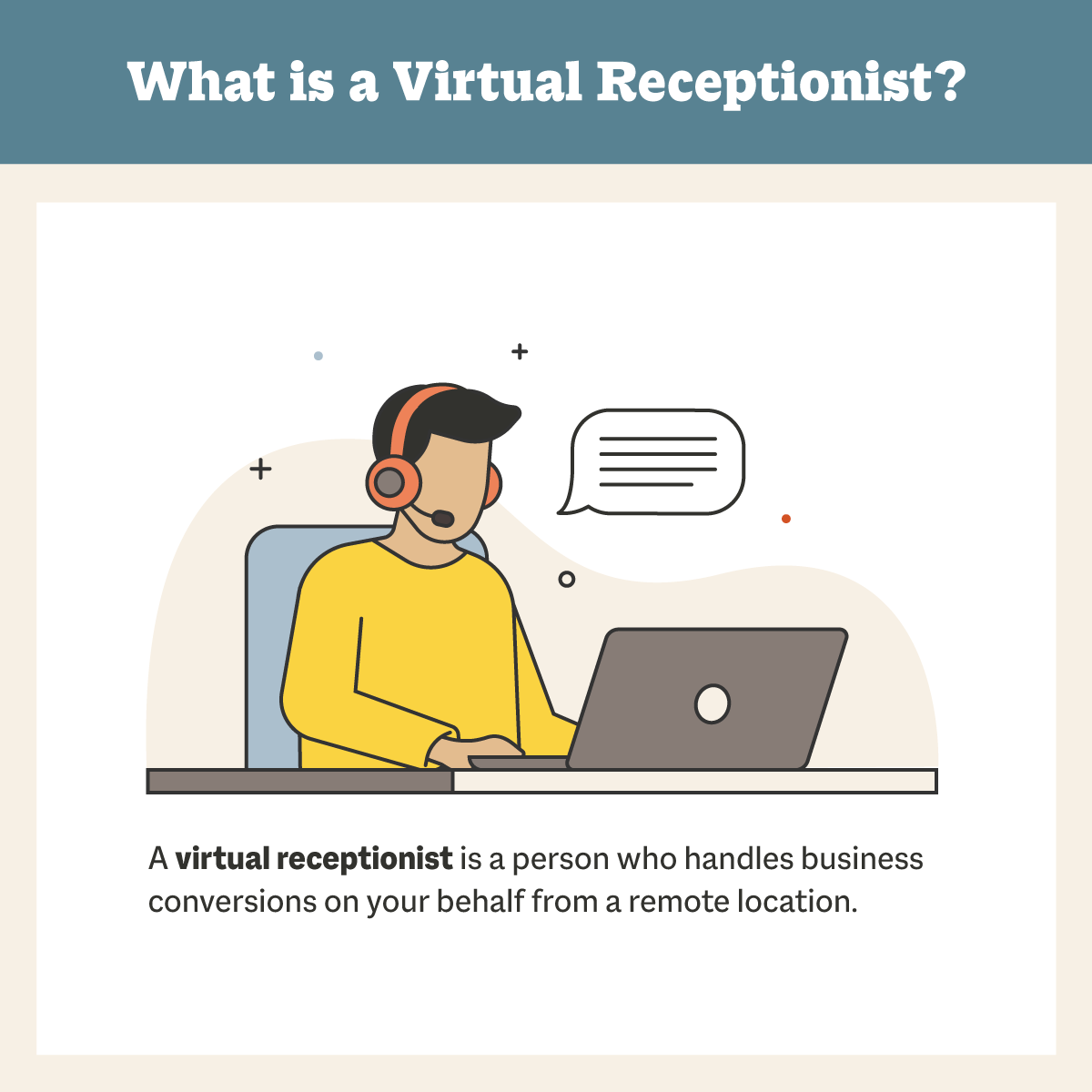
Virtual receptionists differ from simple answering services that provide basic, scripted message-taking. Unlike automated answering services that simply play recordings and route calls, virtual receptionists provide intelligent call handling that seamlessly integrates into your business operations. T
hey function as an extension of your existing team — greeting callers, capturing leads, conducting intake for new customers, and moving conversations forward with minimal friction.
Virtual receptionists deliver measurable operational improvements that directly impact revenue, cost structure and customer satisfaction. These benefits scale with business growth, providing leverage that in-house staff cannot match.
Virtual receptionists handle a wide range of front-line communication tasks that would otherwise require dedicated staff time. These services go beyond simple call answering to provide comprehensive customer interaction management.
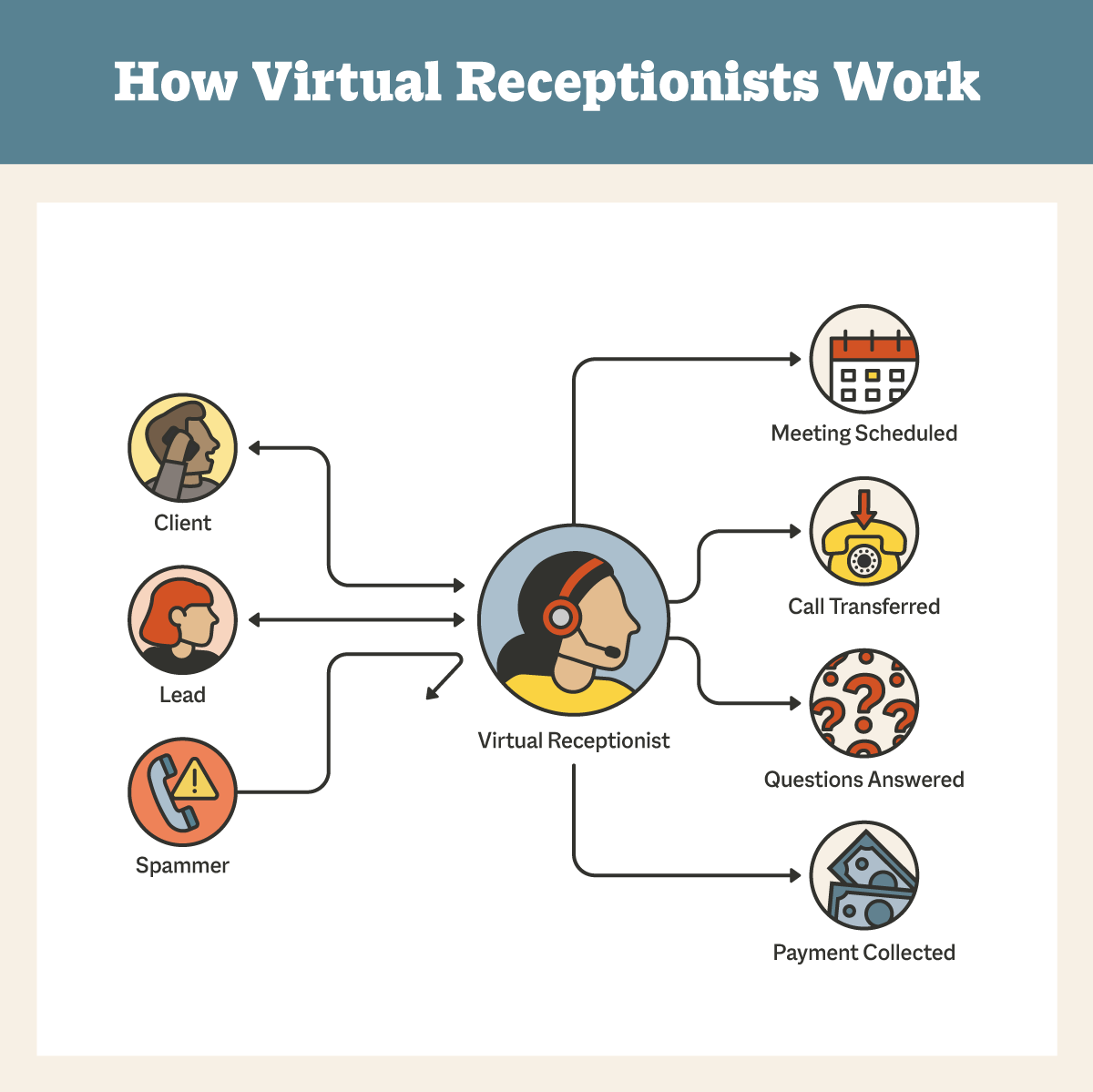
Virtual receptionists greet every caller with customized scripts that reflect your brand voice and business protocols. They determine caller intent through conversational interaction and then route calls to the appropriate team members based on predefined rules.
For calls that cannot be transferred immediately, receptionists take detailed messages, including caller information, the purpose of the inquiry, and the urgency level.
Lead qualification happens during the first call using your specific criteria. Virtual receptionists collect context beyond basic contact information — service area, budget range, project timeline, and custom fields your intake process requires.
This screening ensures you spend time with prospects who are actually a fit for your business rather than tire-kickers who consume resources without converting.
Virtual receptionists book appointments directly on the calendar you already use, eliminating back-and-forth email exchanges. They check real-time availability, offer suitable time slots, and confirm bookings with both parties. Many services send automated appointment reminders and handle rescheduling requests, reducing no-shows and administrative overhead.
Unlike in-house receptionists who work set hours, virtual receptionist services operate around the clock, including evenings, weekends, and holidays. This continuous availability ensures businesses never miss important calls during off-hours when traditional staff are unavailable. After-hours answering services allow businesses to advertise continuous phone availability without requiring internal staff to work nights and weekends.
Virtual receptionists filter spam calls and robocalls, ensuring only genuine customer inquiries reach your team. Advanced services maintain databases of known spam numbers and use caller ID verification to identify solicitors. This filtering protects both your time and your budget by preventing unwanted calls from consuming staff attention or service usage quotas.
Virtual receptionist services operate through three distinct models, each offering different trade-offs between cost, capabilities and complexity handling.
AI receptionist services use conversational AI, natural language processing and automated systems to handle routine calls. These services answer questions, route calls based on caller input and handle straightforward appointment scheduling at low cost and high speed. AI systems operate 24/7 without capacity limits, processing multiple simultaneous calls while maintaining consistent quality. They excel at high-volume, predictable interactions that follow defined protocols.
Virtual receptionist services employ trained professionals who answer calls on behalf of your brand. Live receptionists handle nuanced conversations, manage sensitive topics and adapt to unexpected situations requiring judgment and empathy. These services cost more than AI-only options but provide the relationship-building and complex problem-solving capabilities that automated systems cannot replicate.
Hybrid services combine both approaches, routing routine inquiries to AI systems while escalating complex situations to live receptionists. Smith.ai represents this hybrid model — AI handles high-volume routine calls with instant responses, while live receptionists step in for escalations, sensitive topics and complex scheduling.
Virtual receptionist costs depend more on service model than on industry. AI-only services commonly start below $100/month and scale with call volume.
Live human services for small-to-mid businesses typically run from roughly $300 up to $2,000+ per month, usually billed per minute or per call. Hybrid AI + human models sit between those ranges, combining lower AI costs with metered human escalation.
Most industries pay essentially the same published rates at a given call volume — home services, real estate, and accounting firms generally do not face industry-specific markups from general-purpose providers.
Legal is the exception: specialist legal answering services often charge more per minute than general providers, reflecting additional value from conflict-check workflows, legal CRM integrations, and intake-trained staff.
The table below reflects typical monthly ranges at small-to-mid business volumes (for example, ~100–200 calls or minutes), aggregated from published pricing and cost studies from major virtual receptionist and answering-service providers.
| Industry | AI-based service (typical SMB range) | Live virtual receptionist (typical SMB range) | Specialist option (where applicable) |
|---|---|---|---|
| Home services | $50–$250/month | $300–$900/month | General providers only |
| Real estate | $50–$250/month | $300–$1,700/month (usage dependent) | General providers only |
| Accounting and finance | $50–$250/month | $250–$1,400/month | General providers only |
| Legal / law firms | $85–$800/month (AI or hybrid AI) | $300–$2,100+/month (specialist legal services at SMB volumes) | $360–$1,500+/month for dedicated legal answering plans |
These price ranges are synthesized from pricing published by CloudTalk, GetVoIP, Quo, MyAIFrontDesk, NextPhone, Casegen AI, AnsweringLegal, and Smith.ai
Virtual receptionists adapt to industry-specific requirements, handling specialized intake procedures, terminology, and caller expectations unique to each sector. The following industries benefit particularly from virtual reception services that understand their operational constraints.
Law firms face strict intake requirements, including conflict checks, statute-of-limitations screening, and detailed case information collection. Virtual receptionists qualified in legal intake capture party names, incident dates, insurance coverage, prior attorney involvement, and case type during initial calls.
Statute deadline screening immediately qualifies cases, flagging time-sensitive matters requiring urgent attention. Conflict-of-interest protocols prevent firms from accepting cases that would violate professional responsibility rules.
Priority routing ensures high-value cases — significant damages, clear liability, approaching deadlines — reach senior attorneys quickly rather than sitting in general queues.
Virtual receptionists deliver compliance statements verbatim when required by bar associations, ensuring legal disclaimers are communicated exactly as written. Legal answering services understand the distinction between prospective client screening and attorney-client relationship formation, protecting firms from inadvertent representation issues.
Plumbing, HVAC, electrical, and other home service businesses require emergency triage capabilities that distinguish true emergencies from routine service requests. Virtual receptionists use specific questioning protocols to identify situations requiring immediate dispatch — such as active water leaks, gas smells, electrical hazards, and heating failures in winter.
Emergency calls trigger priority routing to on-call technicians, with location details, property access information, and documented safety concerns. Service area verification ensures calls fall within coverage zones before committing resources. Property detail collection — size, system age, problem history — enables accurate dispatching and preliminary pricing estimates.
Virtual receptionists capture recurring service preferences for maintenance customers, noting equipment types, preferred scheduling windows, and property-specific instructions.
After-hours coverage ensures emergency calls receive immediate response rather than waiting until business hours, preventing property damage and capturing revenue from competitors who route emergencies to voicemail.
Real estate professionals require appointment scheduling that coordinates property showings, buyer consultations, and listing presentations across multiple calendar systems. Virtual receptionists verify caller qualification — pre-approval status, price range, desired locations — before scheduling showings that consume agent time.
Property inquiry management captures specific requirements, including bedrooms, bathrooms, square footage, school districts, and must-have features.
Virtual receptionists route inquiries to appropriate agents based on geographic specialization, property type expertise, and current availability.
Lead capture for open houses, online listings, and marketing campaigns feeds directly into CRM systems with source attribution. Follow-up scheduling ensures timely contact with prospects during the critical decision window when buyer interest peaks after property tours.
Accounting firms, financial advisors, and tax preparation services handle confidential financial information, which requires secure intake protocols. Virtual receptionists collect basic client details — entity type, service needed, deadline urgency — without discussing sensitive financial data over initial calls.
Tax season creates dramatic volume spikes that overwhelm in-house staff. Virtual receptionists provide flexible capacity during peak periods from January through April, then scale back during the slower summer months. This seasonal scalability matches actual demand without permanent staffing commitments.
Appointment scheduling coordinates client meetings, document reviews, and consultation calls while respecting practitioner availability during busy seasons. Virtual receptionists route existing clients to assigned accountants while directing new inquiries through qualification protocols that assess service fit and capacity availability.
Every unanswered call is a revenue decision — one that defaults to whichever competitor picks up first. Virtual receptionist services exist to eliminate that default. The right service model depends on call complexity, volume and how much intake judgment your business requires.
Smith.ai AI Receptionist handles high-volume routine calls at scale, qualifying leads and booking appointments around the clock. Virtual Receptionist services connect callers with live North American-based receptionists who follow your intake protocols for nuanced calls. To find which service fits your call volume and complexity, book a free consultation.

Maddy Martin is Smith.ai's SVP of Growth. Over the last 15 years, Maddy has built her expertise and reputation in small-business communications, lead conversion, email marketing, partnerships, and SEO.


