Take the faster path to growth. Get Smith.ai today.
Affordable plans for every budget.



Automated receptionist services answer and route calls around the clock without full-time staffing, from simple IVR menu systems to hybrid AI and live-agent platforms that qualify leads, schedule appointments, and sync with CRM systems. The right model depends on call complexity, integration requirements, and the extent to which your callers need human judgment.
Who it's for: Operations managers, business owners, and professional services firms evaluating automated and hybrid receptionist services.
Growing businesses face a persistent challenge: every missed call represents lost revenue, yet staffing reception 24/7 costs more than most operations can justify.
Operations managers watch call volume outpace capacity. Professional services partners lose high-value prospects to voicemail. Small business owners choose between answering phones and completing billable work.
Automated receptionist services address this operational constraint by handling calls around the clock without requiring full-time employees.
These systems answer immediately, qualify leads, schedule appointments, and route urgent matters — converting missed opportunities into captured revenue.
An automated receptionist is software or a service that automatically answers incoming phone calls, routes inquiries to appropriate destinations and handles routine tasks like appointment scheduling and information requests without requiring human intervention for every interaction.
Unlike traditional receptionists who physically staff front desks during set hours, automated receptionists operate continuously through technology.
They answer calls instantly, understand callers' needs through voice interaction, execute specific tasks such as booking appointments or collecting information and route complex situations to the appropriate team members.
The technology eliminates the operational constraint of limited reception capacity while maintaining consistent service standards regardless of call volume or timing.
Businesses implement automated receptionists to solve three core challenges: missed calls that lose revenue, staffing costs that limit 24/7 availability and reception bottlenecks that prevent growth.
The systems handle multiple simultaneous calls, never require breaks or vacation coverage and scale capacity without proportional cost increases.
These systems operate through three distinct approaches:
Automated receptionist systems deliver operational advantages that directly address the constraints growing businesses face when call volume exceeds capacity.
Automated receptionist systems operate through sequential stages that process incoming calls from initial connection through final resolution.
When a call arrives, the automated system answers immediately with a customized greeting that reflects your business name and brand voice. The system identifies the caller through phone number lookup, checking for existing customer records or previous interaction history that provides context for the conversation.
The system uses natural language processing to understand what the caller needs based on their spoken words rather than menu selections. AI analyzes conversation content to determine whether the caller needs appointment scheduling, product information, technical support, or other specific services. The system asks clarifying questions to collect required information like contact details, service preferences or urgency level.
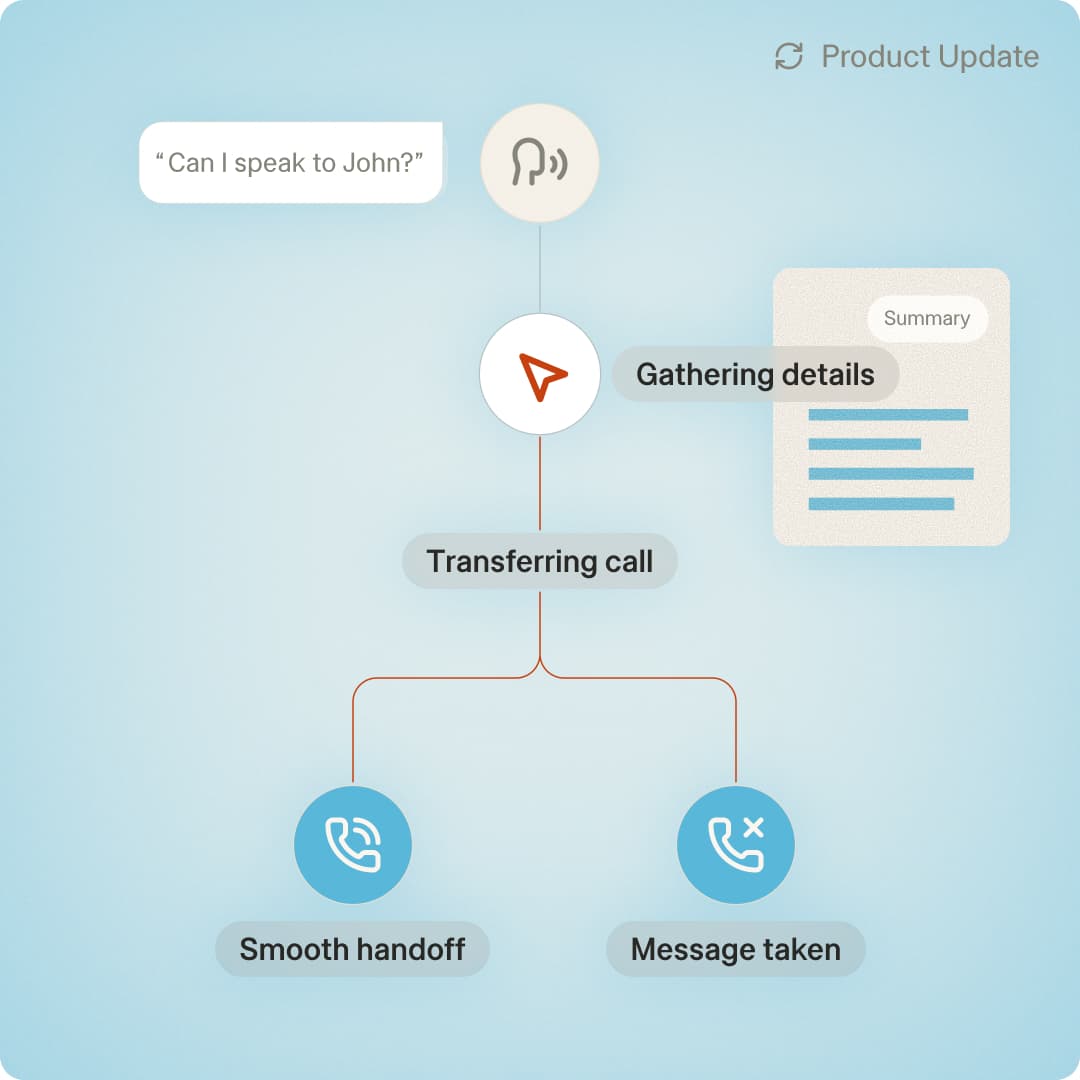
Based on detected intent and gathered information, the system either handles the request directly or routes the call appropriately. Straightforward requests like appointment booking, FAQ answers or message taking get resolved immediately through automated workflows. Complex situations requiring human judgment route to live receptionists or appropriate staff members with full context about the caller's needs.
After handling the call, the system logs all interaction details to your CRM or business management software automatically. It sends confirmation messages, appointment reminders or follow-up information to the caller via text or email. All conversation data becomes available for review, quality assurance and continuous system improvement.
The services below range from fully automated AI systems to hybrid models that combine AI with live receptionists — each suited to different business sizes, call volumes and levels of complexity.
Smith.ai delivers professional call handling through a hybrid model that combines AI with North America-based live agents. This approach eliminates the forced choice between automation efficiency and human expertise, providing businesses with scalable reception services that maintain quality across all interaction types without requiring full-time staffing commitments.
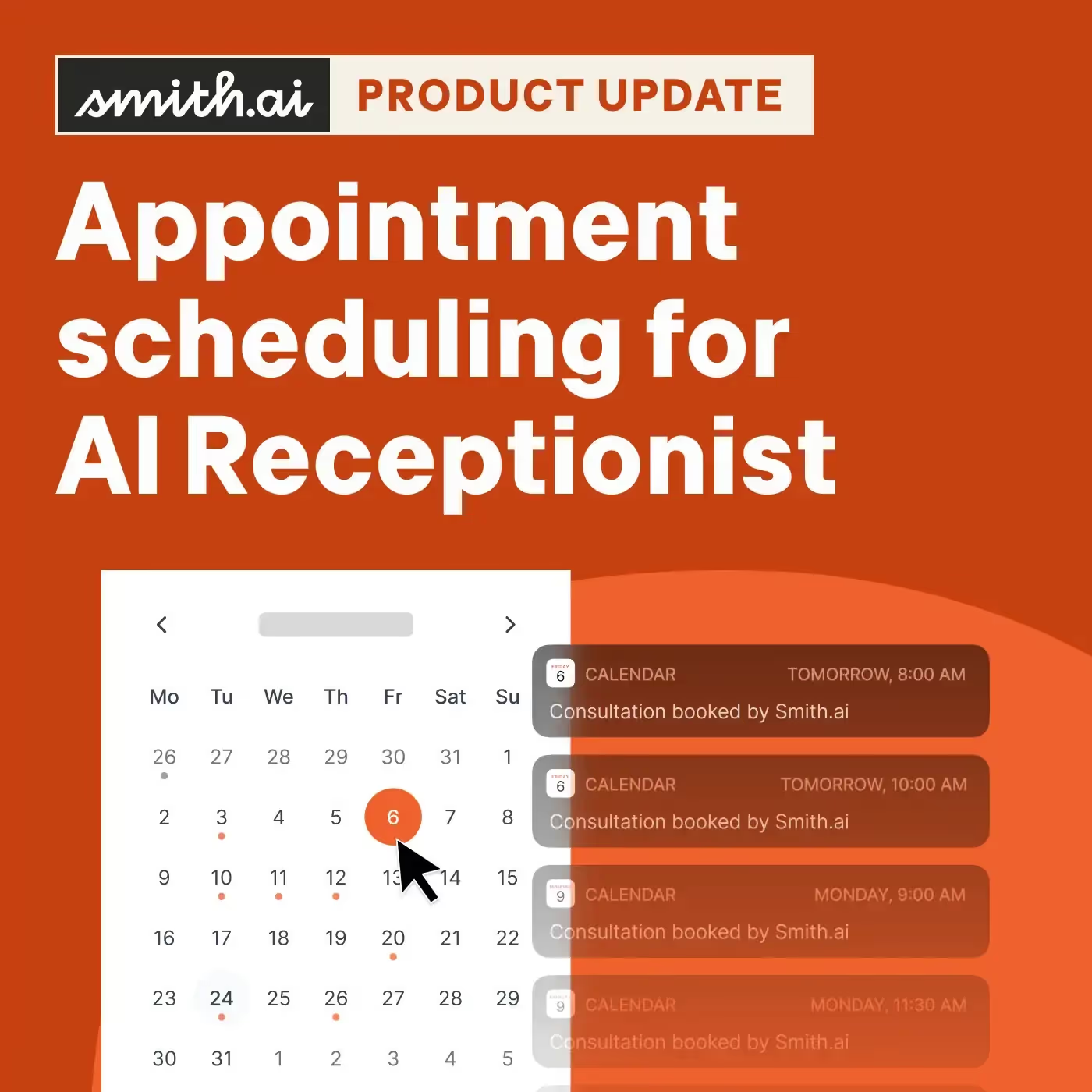
Smith.ai offers two distinct services: the AI Receptionist — an AI-first, human-backed phone answering solution — and the Virtual Receptionist — an AI-enhanced, human-led service for businesses that prefer human agents as their primary call handlers. Both operate 24/7/365.
Key features:
Best for: Businesses needing professional service that scales with growth. Particularly valuable for operations managers overseeing multiple locations, professional services partners managing high-value clients, law firms requiring specialized intake workflows, and small business owners requiring a consistent customer experience without staffing reception positions.
Why it leads: Smith.ai doesn't force the choice between human warmth and tech efficiency. AI handles routine inquiries — typically resolved in two to three minutes — while live agents manage complex situations seamlessly. Twenty-five percent of AI-first calls involve a live agent, demonstrating the hybrid model in practice. This approach bridges the gap between virtual receptionists and automated services, combining both capabilities into a single integrated solution with white-glove onboarding support and per-call pricing transparency.
AbbyConnect centers its service on live virtual receptionists, supported by AI that enhances rather than replaces human interaction. North America-based agents personally handle inbound calls, follow custom scripts, and provide bilingual English-Spanish support. Behind the scenes, AI assists with transcription, summaries, and routing.
Key features:
Best for: Firms that want every caller to reach a real person but still value technology for efficiency. Professional services, healthcare practices, and companies where personal connection drives customer satisfaction.
Nextiva is a unified communications platform that integrates AI receptionist capabilities into its business phone and collaboration tools. The platform provides AI-powered call routing, voicemail transcription, intent-based menus, and automated follow-ups within the same system used for calls, messaging, and video meetings.
Key features:
Best for: Organizations seeking a single, integrated platform where AI reception, phone, and team collaboration operate together. Mid-market and enterprise businesses requiring unified communications.
GoodCall offers an AI receptionist designed for home services businesses including plumbing, HVAC, electrical, and similar trades. The system answers calls continuously, screens for emergencies, and routes urgent jobs accordingly. The platform captures job details, confirms service areas, and syncs with scheduling or dispatch tools.
Key features:
Best for: Trade companies receiving many urgent calls that require round-the-clock coverage and prefer industry-tuned automation over generic call handling. Valuable for operations handling high after-hours emergency call volumes.
My AI Front Desk delivers a straightforward AI receptionist that small businesses can implement quickly without technical expertise. The platform emphasizes ease of setup: businesses define key answers and routing rules, then the AI begins answering and handling calls continuously. The system supports multiple languages, transfers calls, takes messages, and books appointments while learning about the business over time.
Key features:
Best for: Solo operators and small teams requiring fast, affordable automation without complex configuration. Suitable for businesses where technical setup creates implementation barriers.
RingCentral's AI Receptionist integrates into its cloud phone and unified communications platform, providing larger organizations with AI-powered call handling without adding separate vendors. The system interprets natural language to understand caller intent, answers common questions, and routes to appropriate personnel or queues. Integration within RingCentral provides enterprise-grade security, analytics, and administration controls.
Key features:
Best for: Mid-market and enterprise businesses using or planning to adopt RingCentral that want intelligent reception integrated with core telephony infrastructure. Organizations prioritizing security, reliability, and IT department approval requirements.
NextPhone combines an AI receptionist with human agents, creating a hybrid model for local and home-services businesses. The AI handles routine calls, captures basic details, and books appointments, while more complex or sensitive conversations connect to live agents. The system offers simple pricing and basic CRM and calendar integrations with relatively quick setup.
Key features:
Best for: Small and regional businesses wanting AI efficiency without complete reliance on automation for customer calls. Companies seeking cost-efficient coverage with quality safeguards for complex interactions.
AnswerConnect specializes in live virtual receptionist services, providing continuous human answering for businesses requiring every caller to reach a person rather than a machine. Agents follow customized scripts, schedule appointments, relay messages, and patch calls through to on-call staff. The service supports multiple channels including phone, often including bilingual options, with no AI front-end.
Key features:
Best for: Organizations including professional services and healthcare where relationship-building and reassurance matter more than maximum automation efficiency. Businesses requiring human interaction for every call rather than automated responses.
Aircall Voice Agent adds an AI receptionist layer to Aircall's cloud phone system, which serves sales and support teams. The AI answers calls, qualifies leads, and routes them based on intent. Embedded within Aircall, Voice Agent connects with CRMs and help desks, supports call recording and analytics, and integrates into existing call workflows.
Key features:
Best for: SaaS companies and call-heavy teams seeking to automate repetitive phone interactions without changing platforms. Sales and support teams managing high call volumes already using or planning to adopt Aircall.
OpenPhone offers a modern business phone system with AI-assisted reception and SMS integration, designed for startups and lean teams. The AI greets callers, routes calls, and handles simple requests, while the platform unifies voice and text in a clean interface. Teams can collaborate on shared numbers, review call and text history, and set up lightweight automation without heavy configuration.
Key features:
Best for: Growing companies requiring basic AI reception wrapped into an intuitive phone and messaging solution. Teams valuing modern design, SMS functionality, and straightforward implementation over extensive feature sets.
Selecting the right automated receptionist requires evaluating several operational factors that determine which system matches your business requirements.
Different services use different pricing models based on call volume. Understanding call answering service costs helps determine which billing structure — per-call, per-minute, or flat monthly — provides the best value for your patterns. If customers ask complex questions that require judgment, hybrid human/AI services deliver better outcomes than AI-only systems.
Ensure your automated receptionist connects with existing business tools — CRM platforms, calendar systems, payment processors and industry-specific software. Direct integration eliminates manual data entry and enables automated workflows that maximize efficiency.
Fully AI solutions cost less than hybrid human/AI services but offer less flexibility for complex interactions. Calculate the value of captured calls against service costs to determine ROI.
Some sectors like legal, healthcare or financial services have unique requirements including compliance protocols, confidentiality standards and specialized terminology. Verify that your chosen system understands industry-specific processes and regulatory constraints.
If your customers speak multiple languages, ensure your service provides appropriate language support. Consider how much customization you need for brand voice, greeting scripts and call-handling protocols. Some services offer extensive personalization while others provide standardized approaches.
Automated receptionists eliminate missed revenue from unanswered calls while freeing staff to focus on growth rather than phone coverage.
Smith.ai provides both AI Receptionist and Virtual Receptionist services — individually or combined in hybrid models that balance automation efficiency with human expertise.
Both services capture every call immediately and maintain consistent service quality across all interaction types. Schedule a free consultation to discuss which model fits your business.
Related reading:

Maddy Martin is Smith.ai's SVP of Growth. Over the last 15 years, Maddy has built her expertise and reputation in small-business communications, lead conversion, email marketing, partnerships, and SEO.


.avif)