Take the faster path to growth. Get Smith.ai today.
Affordable plans for every budget.



Organizations deploying AI-powered automated call systems need comprehensive security protecting against synthetic voice attacks, unauthorized access, and data breaches that can devastate growing businesses.
Both fully automated systems and human-operated platforms require security infrastructure to defend customer data, authenticate users, and protect communication channels against sophisticated threats targeting modern communication infrastructure.
Traditional security approaches fail when scaling organizations face evolving attack vectors specifically designed to exploit AI vulnerabilities and voice-based systems.
The right security framework enables robust protection while supporting business growth and maintaining operational efficiency during scaling, without compromising customer trust or regulatory compliance.
AI call system security is a comprehensive framework of technical controls that protects AI-powered phone systems and virtual receptionist platforms from traditional telephony threats and AI-specific vulnerabilities, such as voice deepfakes and synthetic voice attacks.
This security framework protects modern communication infrastructure through overlapping requirements. AI-automated systems handling calls without human involvement require protections against synthetic voice attacks, model poisoning, and algorithmic manipulation.
Virtual receptionist platforms that use human agents to handle calls require secure access controls, encrypted communication channels, and comprehensive session monitoring to ensure appropriate data access.
Both approaches depend on voice authentication, encryption, threat detection, and compliance controls, with implementation differences reflecting whether AI algorithms or human agents make real-time decisions.
Traditional Voice over Internet Protocol (VoIP) security focuses on network-level encryption and session authentication, while call system security extends beyond these basics to address AI-specific vulnerabilities and advanced threat detection.
AI call system security operates through several foundational approaches that protect the communication infrastructure from traditional and AI-specific threats:
Traditional security approaches create systematic vulnerabilities that compound as businesses scale and threat landscapes evolve:
Organizations implementing a comprehensive AI call system security gain measurable advantages across financial protection, operational efficiency, and business growth:
AI call system security operates through multiple validation stages, from initial authentication through continuous monitoring, protecting both automated systems and human-operated platforms through foundational infrastructure adapted to different operational contexts.
Security processes begin when callers initiate connections to automated systems or when agents log in to platforms.
Voice biometric analysis extracts unique characteristics from caller voices for automated systems, while agents authenticate using multi-factor authentication that combines passwords, mobile verification, and workstation security checks.
Advanced systems detect potential voice synthesis attacks before authentication by examining temporal patterns in voice frequency, assessing temporal consistency, and identifying acoustic anomalies indicative of artificial generation rather than human speech production.
This prevents attackers from using AI-generated voices to impersonate authorized personnel, customers, or legitimate agents.
Rather than trusting after initial authentication succeeds, systems implement continuous identity verification throughout sessions.
Continuous validation monitors AI decision-making patterns for anomalies, such as unusual transaction requests or conversation patterns inconsistent with authenticated identity.
For human-operated platforms, systems monitor agent session security throughout call handling, requiring re-authentication if the security posture changes when accessing sensitive information or attempting actions outside assigned permissions.
Access permissions adjust dynamically based on security evaluations, with systems requiring additional verification, limiting available actions, or terminating sessions when anomalies occur.
AI components processing voice data face unique attacks requiring specialized defenses across both service types.
Defense mechanisms monitor training data for malicious modifications that could compromise AI behavior, while detection systems identify manipulated voice inputs designed to bypass security systems.
These mechanisms protect primary call-handling algorithms in automated systems and AI components supporting human agents, including natural language understanding, call routing, and sentiment analysis.
Defenses prevent attackers from manipulating AI systems to approve unauthorized requests or expose sensitive data.
Throughout calls, AI processing pipelines maintain security controls at each stage. Speech recognition systems convert voice to text within encrypted processing environments, preventing unauthorized access to raw audio data, while intent classification analyzes the caller's purpose within secure systems.
For human-operated platforms, monitoring tracks agent access to customer records, compliance with security protocols during conversation handling, and data export activities.
Comprehensive monitoring operates simultaneously across both contexts, analyzing access patterns for unauthorized attempts, tracking decision-making for manipulation indicators, and generating real-time alerts when security thresholds are exceeded.
Security frameworks maintain detailed audit trails for all interactions, whether processed by AI systems or handled by human agents. Compliance recording systems capture communications, meet regulatory requirements, and provide configurable retention policies that address industry-specific mandates.
Automated compliance monitoring validates ongoing adherence to security protocols, generates required reports for regulatory authorities, and maintains documentation supporting audit processes.
This ensures both operational security and regulatory compliance without requiring manual oversight of every interaction.
Transform your communication infrastructure with comprehensive security that scales with your business growth and adapts to evolving threats.
Before selecting any security technology, you need a clear picture of your regulatory obligations and current vulnerabilities. Document all regulations applicable to your business operations, including data protection requirements, financial regulations, and telecommunications compliance.
A legal practice handling client communications faces different requirements than an HVAC company scheduling service calls, but both need to protect customer information appropriately.
Legal firms must consider attorney-client privilege protection, while service companies focus on preventing unauthorized access to customer addresses and payment information.
Evaluate your current call recording storage practices, customer data handling procedures, and existing security controls to establish your baseline. This foundation becomes crucial for the vendor selection process that follows.
With your compliance requirements documented, you can now establish the minimum security standards any vendor must meet. Evaluate vendors maintaining formal certifications rather than relying on marketing claims.
Ask about ISO 27001 certification for information security management and SOC 2 Type II certification for service organization controls.
Verify vendors maintain required certifications and provide documentation of security controls protecting customer data throughout processing. Request integration documentation, API specifications, and evidence of third-party security assessments.
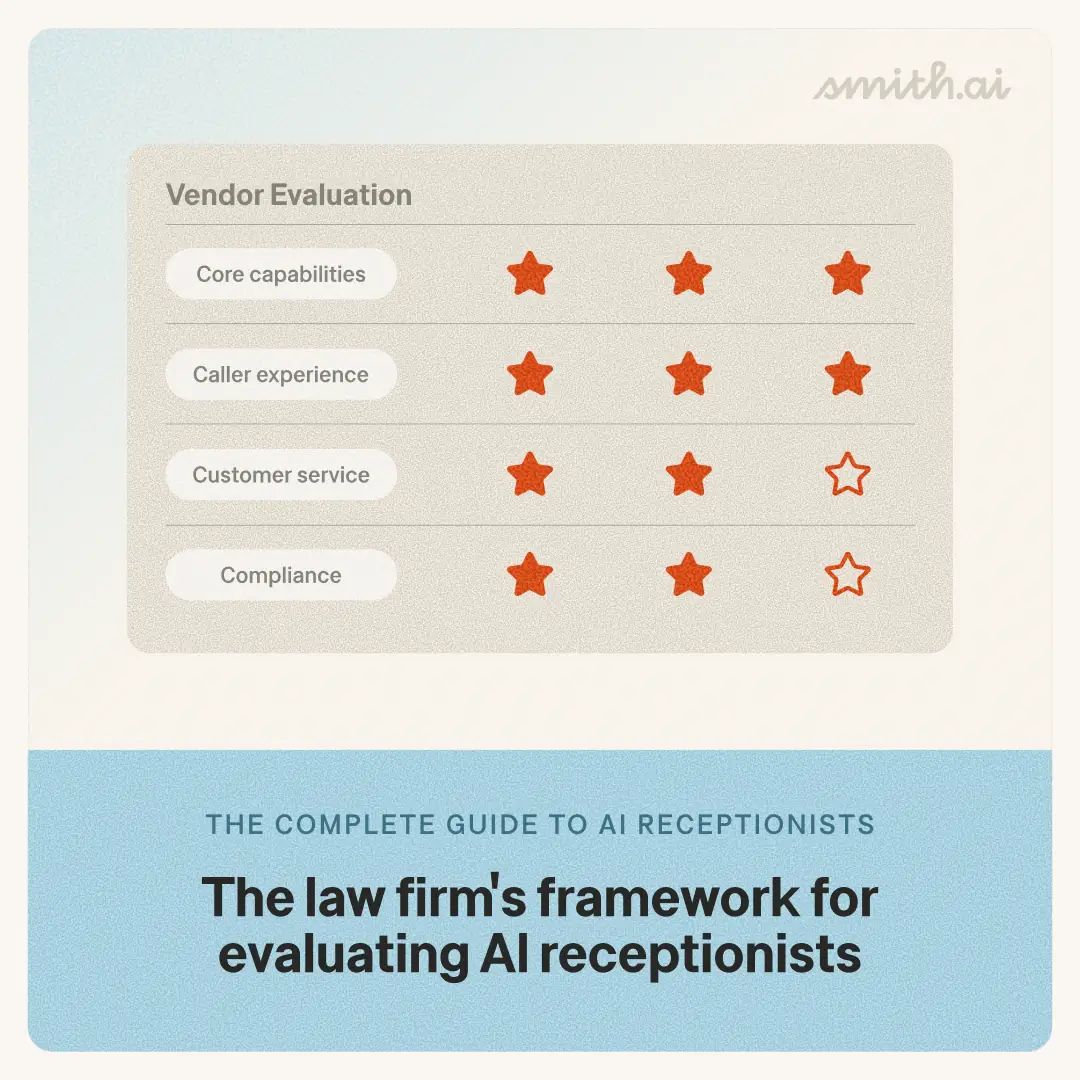
Create an evaluation matrix scoring vendors across critical security dimensions. Assess integration architecture with existing systems, API documentation quality, pre-built integrations, webhook capabilities, and conversation history preservation.
An accounting firm using specific CRM software needs different integration capabilities than a small business using basic contact management tools. Request security testing results, including penetration test reports, vulnerability assessments, and incident response procedures.
Schedule product demonstrations with realistic scenarios from your business operations, ensuring vendors provide specific details on encryption, key rotation, monitoring capabilities, and incident response procedures.
Rather than implementing across your entire organization immediately, start with controlled testing that validates security performance without risking your most sensitive operations.
Deploy initially to non-sensitive categories, such as general inquiries; limit deployment to specific departments; and run parallel systems during transition periods.
This staged approach lets you identify integration issues, security gaps, and user experience problems before they impact critical business operations.
Establish daily security monitoring routines, validating integration performance, collect user feedback on usability and security concerns, and document compliance control validation in production environments.
Define measurable success criteria, including zero security incidents, passed compliance validation, user acceptance, and performance metrics. These benchmarks determine whether you proceed to full deployment or need additional adjustments.
Your pilot success creates the foundation for production deployment, requiring immediate activation of monitoring and response capabilities.
Implement monitoring dashboards, document incident response procedures, and configure continuous monitoring for unauthorized access attempts.
Establish structured ongoing operations: daily security monitoring reviews, quarterly incident response drills and compliance audits, and annual vendor certification reviews.
The key insight is that security operations adapt to changing threats while maintaining the protective framework that enables confident business growth.
AI call system security provides the protection growing businesses need for customer communications.
You avoid costly data breaches while detecting threats faster than traditional approaches, enabling confident scaling without compromising security standards or operational efficiency.
Smith.ai provides AI Receptionists and Virtual Receptionists with professional call handling that prioritizes data protection and secure communication practices, enabling your business to maintain customer trust while scaling operations efficiently.

Maddy Martin is Smith.ai's SVP of Growth. Over the last 15 years, Maddy has built her expertise and reputation in small-business communications, lead conversion, email marketing, partnerships, and SEO.