Take the faster path to growth. Get Smith.ai today.
Affordable plans for every budget.



Traditional call routing architectures make decisions solely based on caller input — IVR menu selections and queue availability — without accessing customer data systems.
The routing engine processes authentication requests, menu navigation, and queue assignment independently of CRM platforms, transaction databases, and interaction histories that contain comprehensive caller context.
This architectural separation creates systematic inefficiencies that compound at scale: agents spend time in initial interactions gathering information already stored in business systems, and customers repeat details they've already provided across previous contacts.
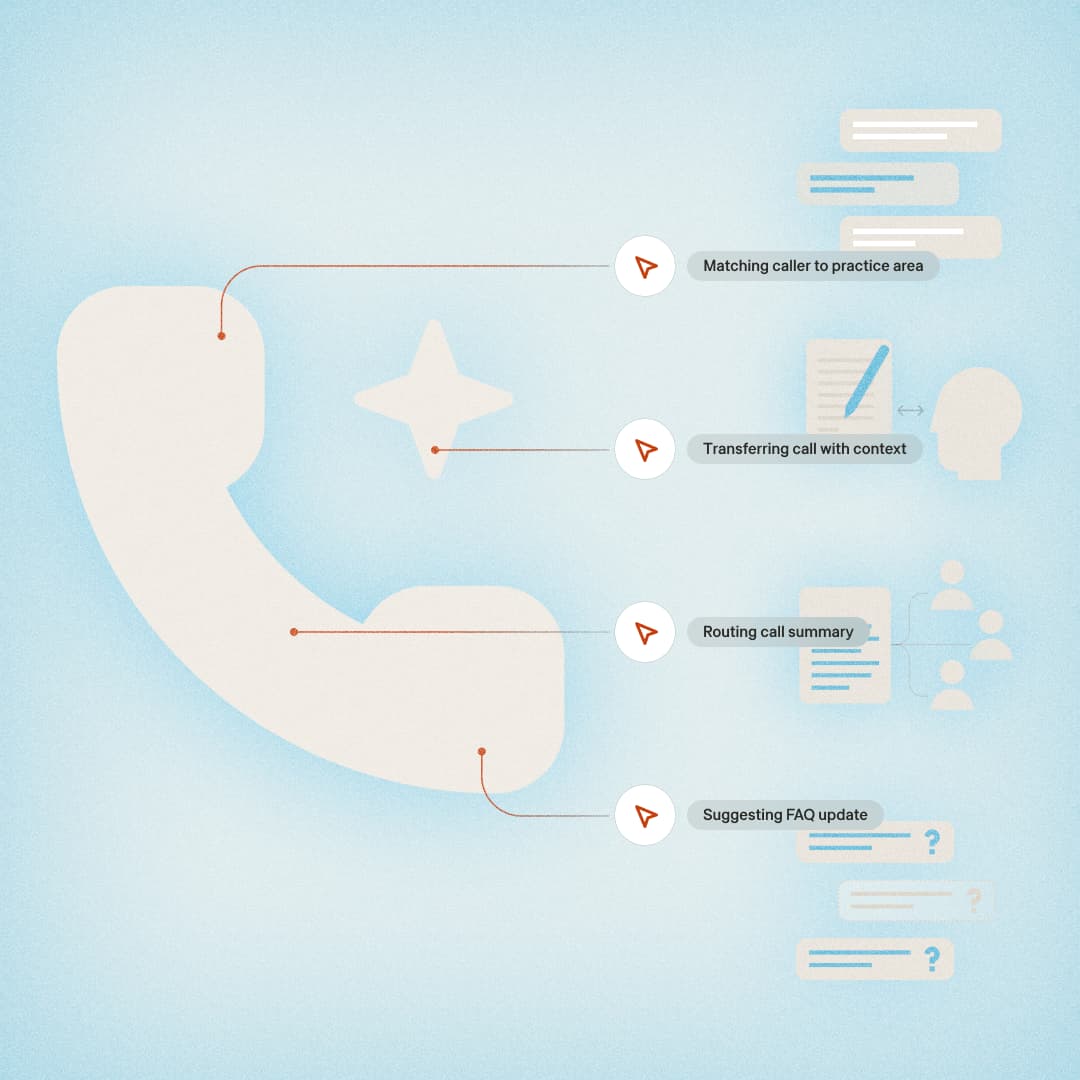
Context-aware call handling addresses these limitations by integrating caller data into routing decisions, enabling systems to make informed pathway determinations before calls reach agents.
Context-aware call handling is a call management system that leverages real-time analysis of customer data, interaction history, and behavioral signals to inform routing decisions, agent assignments, and interaction customization.
The system integrates with your CRM platforms, transaction databases, and interaction history systems to evaluate caller identity, account characteristics, and previous contact data before executing routing logic.
This differs fundamentally from traditional interactive voice response systems, which route calls based solely on menu selections through predetermined hierarchies.
Context-aware systems operate through three functional layers.
Context-aware systems incorporate comprehensive caller understanding into every decision point throughout the interaction lifecycle.
Context-aware call handling leverages several integrated concepts that transform basic routing into intelligent triage:
These concepts combine to create routing intelligence that operates independently of static menu structures.
When these concepts operate together, they produce measurable operational improvements, which include:
Understanding these benefits provides context for examining how context-aware systems operate technically to deliver these operational improvements.
Context-aware call handling operates through a systematic process that analyzes caller data, applies business logic, and executes routing decisions within seconds of call connection.
When a call arrives, Automatic Number Identification (ANI) protocols capture the originating phone number during the initial signaling phase, triggering API queries to CRM systems, ticketing platforms, and transaction databases — typically executing within 200-500 milliseconds during the first ring.
For known callers, the system instantly identifies account tier, service history, and current status (open tickets, scheduled appointments, payment standing). For unknown numbers, the system flags the caller as a new prospect requiring different routing logic than established customers.
The system evaluates retrieved data against predefined business rules to calculate routing priority. Priority algorithms consider multiple factors simultaneously: a caller with $100K annual contract value receives different treatment than a $5K account, while open critical support tickets override standard routing regardless of account size.
The analysis also considers the current operational context — if specialist queues are at capacity, the system determines whether priority callers should wait for specialists or be routed to available generalist agents, with appropriate escalation protocols.
Based on priority assessment, the system executes routing decisions. High-priority calls — VIP accounts, active escalations, time-sensitive issues — route to specialist teams or senior agents, bypassing standard queues entirely. Routine inquiries from standard accounts follow normal routing pathways.
The routing logic monitors operational factors: agent availability, current queue depths, and specialist capacity. If priority routing creates excessive wait times because all specialists are engaged. In that case, the system implements fallback protocols — routing to qualified generalists with escalation paths or scheduling callbacks rather than forcing extended holds.
When an agent receives a routed call, comprehensive caller information displays immediately: customer identity, account summary with value indicators, recent interaction history across all channels, open support tickets, and scheduled appointments.
This context delivery eliminates the interrogation phase that frustrates callers in traditional systems. Instead of asking "Can I get your account number?" agents can begin: "I see you called about the invoice question yesterday — were you able to access the revised statement we sent?" This continuity demonstrates relationship value while accelerating resolution.
Throughout each interaction, the system logs detailed data: routing decisions made, contextual factors considered, handle time, resolution outcome, and satisfaction score. This performance data feeds continuous optimization, revealing which routing pathways produce optimal outcomes for different caller profiles.
Analytics identify routing inefficiencies: call types that consistently require multiple transfers indicate logic failures, extended handle times suggest gaps in contextual information, and variations in satisfaction by routing pathway reveal which decision rules optimize outcomes. Your system becomes more effective as empirical data refines routing algorithms.
These operational stages provide the technical foundation for context-aware routing. Translating this understanding into practical implementation requires a systematic design methodology.
Building context-aware call handling requires systematic integration of your existing data systems with intelligent routing logic. The implementation process follows five sequential stages.
Begin by documenting your current call routing architecture and identifying opportunities for improvement. Record typical call flows from initial contact through resolution, noting where agents spend time gathering context or where calls transfer unnecessarily.
Identify all customer data sources available for integration: your CRM system, transaction databases, support ticket platforms, appointment scheduling systems, and any industry-specific software containing caller information. Evaluate API availability and data access methods for each system.
Map which caller attributes would improve routing decisions — account tier, purchase history, open support cases, payment status, previous interaction patterns. Prioritize data elements that appear most frequently in agent workflows or that correlate strongly with call outcomes.
Translate your operational priorities into explicit routing rules. Determine which caller attributes trigger which routing actions.
Establish priority tier structures based on your customer value segmentation. Define how account status, order value, or subscription level influences queue position and agent assignment.
Create routing pathways for distinct call categories. Sales inquiries route to specialized sales teams. Technical issues are routed by product category and complexity — billing questions route to financial services or self-service systems for simple balance inquiries.
Specify escalation triggers: which contextual signal combinations require immediate supervisor involvement, what threshold values initiate priority protocols, and how your system handles calls lacking specific contextual data.
Document these rules with sufficient precision to encode into routing engines while maintaining flexibility for adjustment based on performance data.
Build decision frameworks that specify exactly how contextual signals influence call handling at each interaction point.
Define priority algorithms that combine multiple signals — a caller with high lifetime value AND an open critical support ticket receives different treatment than a high-value caller with a routine inquiry.
Establish routing pathways that consider both caller context and operational capacity. Your system should route priority calls to available specialists, but provide fallback protocols when specialist queues reach capacity.
Create decision trees specifying which combinations of caller attributes, interaction history, and current operational status trigger which routing actions.
Deploy technical connections between your call management platform and identified data sources. Configure API connections or middleware integration platforms to enable real-time data queries during call connection phases.
Implement agent screen integration that displays aggregated context when answering calls. Your agents should see caller identity, account summary, interaction history, and relevant business system data without having to switch between applications.
Validate data accuracy through systematic testing. Verify CRM data displays correctly, interaction histories appear complete, and priority algorithms execute as designed.
Conduct testing with controlled call samples, monitoring system performance, including data query response times, routing accuracy rates, and integration error frequencies. Address data quality issues and integration failures before full deployment.
Establish analytics tracking routing effectiveness metrics: conversion rates by routing pathway, first-call resolution rates by call category, handle time variations correlated with context availability, and satisfaction scores by routing decision types.
Compare performance against baseline metrics from your initial audit to quantify improvement. Identify routing inefficiencies through systematic analysis — call types that consistently require multiple transfers indicate routing logic failures, and extended handle times suggest gaps in contextual information.
Adjust priority frameworks and routing rule parameters based on empirical outcome data. Implement controlled testing methodologies to evaluate routing logic modifications against control groups before system-wide deployment.
Successful implementation depends not only on technical execution but also on operational practices that ensure system effectiveness and sustainability.
Context-aware call handling represents a fundamental architectural shift from uniform call processing to intelligent routing, leveraging comprehensive customer data and analytical capabilities.
Contact centers that architect call handling around contextual intelligence create sustainable operational advantages — delivering differentiated customer experiences while maintaining efficiency that supports profitable scaling.
Learn how AI Receptionists from Smith.ai implement context-aware call handling with comprehensive CRM integration and intelligent routing that scales with your business growth.

Maddy Martin is Smith.ai's SVP of Growth. Over the last 15 years, Maddy has built her expertise and reputation in small-business communications, lead conversion, email marketing, partnerships, and SEO.
.avif)

.webp)
.jpg)


