Take the faster path to growth. Get Smith.ai today.
Affordable plans for every budget.


Personal injury firms connect 20.6% of qualified callers on the call, according to Smith.ai's Legal Intake Report: 13.4% by transfer and 7.2% by booked consultation. PI firms with scheduling enabled connect 69.3%, against 15.3% without it. A short, consistent question set and a transfer-then-book ending account for most of that difference.
Updated October 2026
Personal injury firms connect about 1 in 5 qualified callers (20.6%), according to Smith.ai's Legal Intake Report, an analysis of 3.2 million answered calls to 4,210 U.S. law firms. Most of those connections are live transfers to someone at the firm. Only 7.2% of qualified PI callers leave the call with a consultation booked.
Below are the intake questions Smith.ai recommends for personal injury, the conversion numbers behind them, and how the best-converting PI firms end the call. Every rate here is a share of qualified leads: callers the receptionist judged to be viable prospects under the firm's own criteria.
About one in five. Across live-receptionist calls from June 2022 to July 2026 and AI receptionist calls from December 2025, 20.6% of qualified personal injury leads connected with the firm before the call ended. That breaks down to 13.4% transferred to someone at the firm and 7.2% booked into a consultation.
The 7.2% booking rate is the lowest of any practice area in the report. The report's explanation is simple: "Criminal defense and personal injury lean on transfers, because the caller may need a lawyer today." The trouble is that a transfer only works if someone at the firm is free to pick up. Across all practice areas, 33.7% of transfer attempts on qualified leads reached someone at the firm. The rest ended in a message.
Yes. PI firms whose receptionists are set up to book consultations connect 69.3% of qualified leads, against 15.3% at PI firms without scheduling enabled.
That 54-point gap matters because the report names personal injury "the area most often called unbookable." The usual objection is "booking doesn't work in my practice area," and the PI call records don't support it. "Scheduling enabled" means the firm has asked its receptionists to book consultations for qualified callers. It's a setting in the account, and the firm decides whether to turn it on.
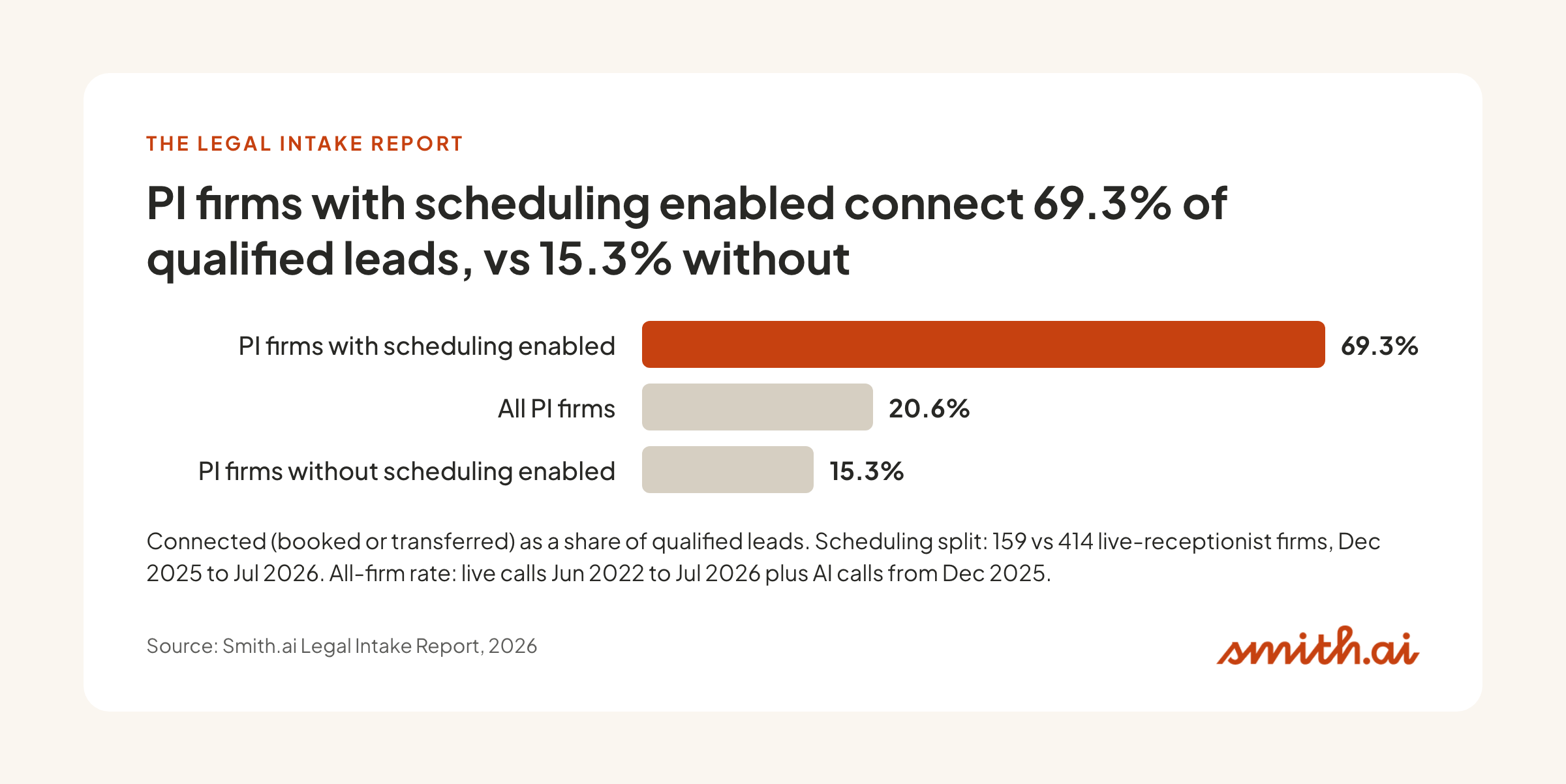
One caveat from the report's methodology: firms chose their own setups, so the gap describes what each setup delivers for the firms that run it. It isn't a controlled test of switching. To see how PI compares with family law, criminal defense, estate planning, and other areas, read our intake conversion benchmarks by practice area.
A personal injury intake form should pin down when and where the incident happened, who was at fault, whether the caller was hurt and treated, and whether another attorney is already involved. Smith.ai's account build guide for law firms (August 2026), published in the report, recommends seven PI screening questions. Five of them:
The other two questions cover the injuries themselves and the caller's role in the accident. The full question set and methodology, including the answer formats a receptionist records for each question, are in the report.
Each of these does one of the four jobs the report assigns to a screening question: fix a date, fix a place, name the other party so a conflict check can run, or record what has already happened. If a question on your current form does none of those, it probably belongs in the consultation rather than on the intake call.
Transfer first, and book a consultation if no one at the firm answers. That's the end-of-call action the report recommends for personal injury, because some PI callers do need to speak with a lawyer today.
The booking offer is what keeps a failed transfer from turning into a lost lead. Across practice areas, firms that offer a booking when a transfer fails connect 63.4% of qualified leads, compared with 17.7% for firms that only transfer. The Legal Intake Report has the full breakdown. In practice it's one more line in your intake instructions: if the transfer doesn't connect, offer the caller a time on the calendar. Smith.ai's appointment booking puts that time straight onto the firm's calendar while the caller is still on the line.
A personal injury intake specialist answers the call, runs the firm's screening questions, decides whether the caller meets the firm's criteria, and sets the next step before the caller hangs up. The median call with a qualified lead in the report runs 6.0 minutes, and that's the whole window to win or lose the case.
Plenty of PI firms staff this role in-house. Others hand it to an intake partner so the phone is covered on nights, weekends, and the afternoons when the whole team is in depositions. Smith.ai runs intake end-to-end for law firms: the AI Receptionist answers and screens routine calls, and 500+ North America-based live agents, many of them former paralegals and court staff, step in for the calls that need judgment or a human voice. Firms can choose the hybrid AI + human setup or to have human virtual receptionists answer from the start on every call. Either way, the same question set runs on every call and every answer is recorded.
The record then needs to land somewhere useful. Smith.ai sends intake data to the firm's practice management system, including Clio, Lawmatics, and MyCase, so the attorney opens the consultation with the incident date, state, fault, and treatment history already in the file.
Use a template as the starting list, then cut it to the questions your firm needs to decide whether to take a case. The report's own guidance is that "a firm keeps the questions that apply to its practice and drops the rest."
Three things make a template work on the phone:
The same template works for live agents and an AI receptionist. The report notes that its question sets "apply to live and AI receptionists alike."
Smith.ai has handled 25M+ calls since 2015 and runs intake for 5,000+ law firms. Personal injury is one of the three practice areas that bring the most calls in the report. If your PI intake is converting closer to 15% than 69%, the fix is usually in the instructions your intake team follows rather than the leads you're buying. See AI Receptionist pricing or download the Legal Intake Report for the complete PI question set. Running intake for more than one practice area? We've also published the recommended questions for family law intake and criminal defense intake.


