content hub
>
>

Legal Client Intake Questions: What to Ask to Book More Consultations

By
Danielle Whyte
Published 
2026-11-12
Updated 
2026-11-12

Legal Client Intake Questions: What to Ask to Book More Consultations

2026-11-12
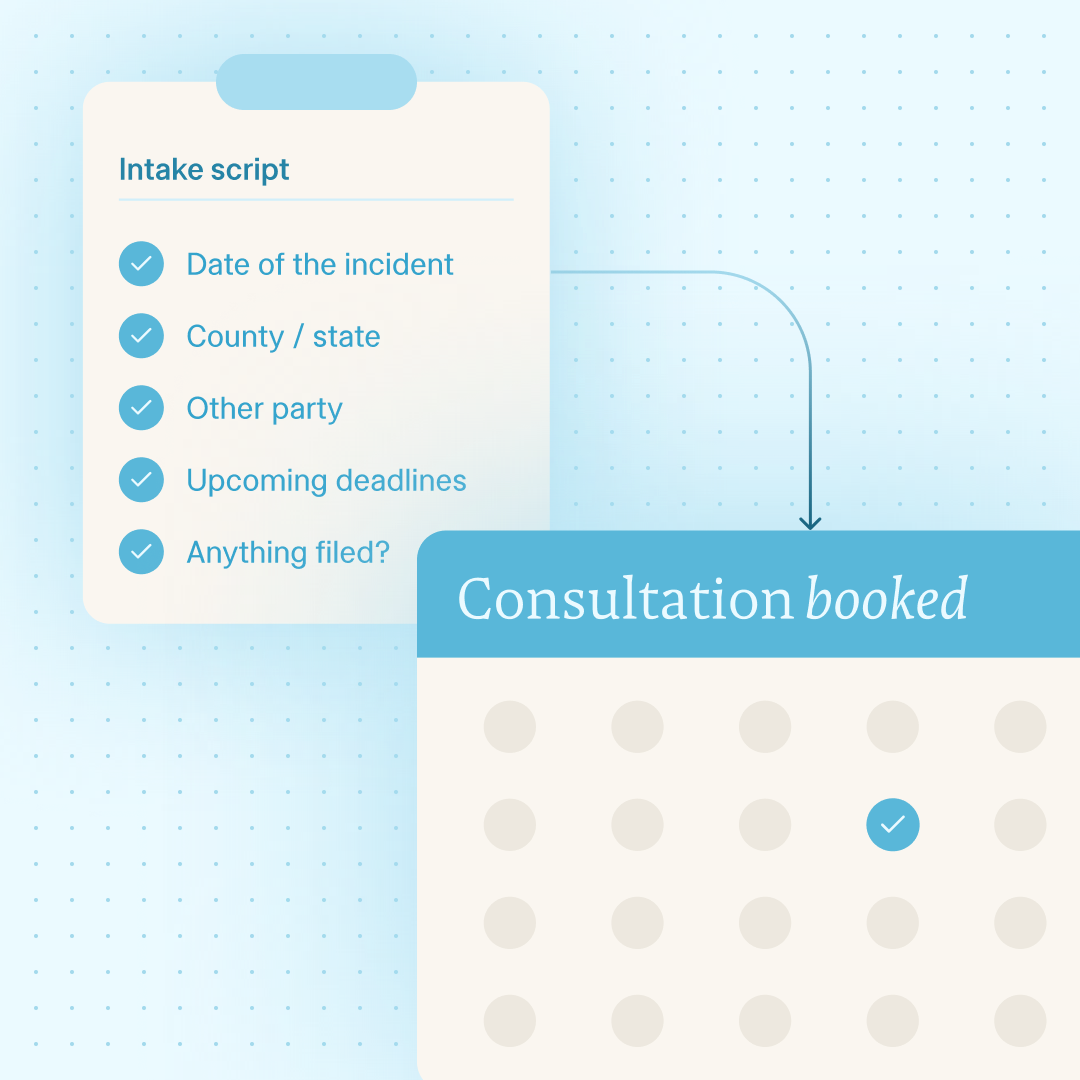
An intake script with screening questions checked off (date of the incident, county or state, other party, upcoming deadlines, anything filed) leading to a booked consultation on the calendar.

In Part III, we discussed how to keep intake and scheduling open around the clock, so every qualified caller is offered a consultation, whether they call at 2 p.m. or 9 p.m. This post covers what happens once that offer is on the table: why some qualified callers still hesitate, and how the questions your intake team asks change the answer.

Smith.ai's Legal Intake Report points to two parts of the intake script that firms control:

  • Screening depth: Qualified leads who were asked seven to nine screening questions connected with the firm at 37.8%, against 31.2% for three or four questions. The extra questions added under a minute to the call.
  • Consultation fees: Firms that charge for the consultation can keep their fee and still book: set expectations about the fee, keep offering a time, and let screening questions spot callers with a deadline.

Why qualified callers hesitate

Up to now, this series has been about making sure the booking offer exists. The Legal Intake Report puts it plainly: objection handling and price framing matter only where a next step is offered. Once your intake team offers a consultation on every qualified call, the next question is why some callers still say no.

Price is the reason most firms expect. It matters, but less than most assume. Among qualified callers who declined and gave a reason, price came up in 17.9% of declines outside family law. In family law, it came up in 28.7%.

So for most firms, price isn't the main reason qualified callers walk away. Price comes up most where the firm charges for the first consultation, which many firms do deliberately. The goal isn't to drop the fee. It's to make sure the fee doesn't end the call.

How to keep booking when you charge for consultations

Should law firms charge for consultations? That's the firm's call, and the report doesn't argue for dropping the fee. It does show that a fee raises the stakes on the call itself. At firms with scheduling enabled:

  • Family law: 28% of qualified leads booked at firms that charge for the consultation, against 54% at firms that don't charge (23 firms against 51).
  • Every other case type: 30% against 61%.

The report is careful about what that gap means: the fee is a filter the firm chose, and the lower booking rate is its cost, not a judgment on the firm. What a fee buys back in show rates and retained clients is outside this data. The takeaway: when you charge, how your intake team handles the fee on the call matters more.

Family law adds one more useful detail. Callers whose matter was forced on them (they'd been served, their spouse had filed, or a hearing was set) named cost in 28% of their stated declines.

Callers still deciding whether to start a divorce, custody, or adoption matter named it in 33%. A dated, imposed need is less price-sensitive than one the caller is still weighing. That's useful on the call: callers with a court date or a filed case are a bit less likely to balk at a fee.

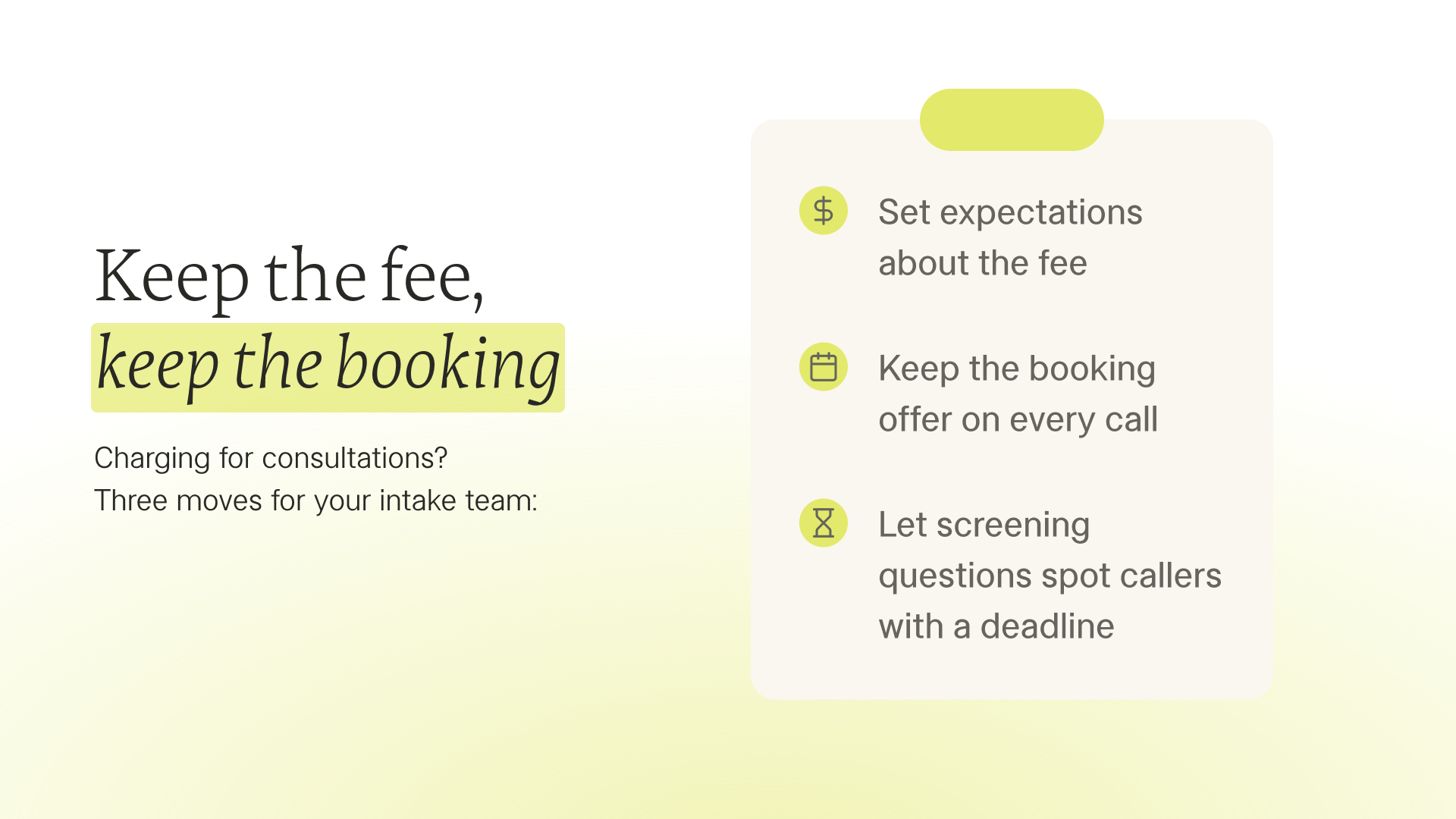
Keep the fee, keep the booking: three moves for your intake team when you charge for consultations. Set expectations about the fee, keep the booking offer on every call, and let screening questions spot callers with a deadline.

We recommend three moves when you charge a fee:

  • State the fee up front. Have your intake team state the fee plainly, along with what the consultation covers, so it isn't a surprise at the end of the call.
  • Keep the booking offer on every call. A caller can't book a paid consultation that's never offered, either.
  • Let your screening questions tell callers apart. "Has anything been filed?" and "Any upcoming court dates?" show your team which callers have a dated need (and are less likely to balk at a fee) and which are still weighing their options.

How many intake questions should a law firm ask?

Seven to nine screening questions. Qualified leads whose intake included seven to nine booked at a rate of 29.9%, the highest of any range in the report.

Screening questions askedQualified leads who booked
2 or fewer15.7%
3–422.4%
5–623.3%
7–929.9%
10–1422.1%

Two things stand out:

  • Deeper screening doesn't scare callers off. Through seven to nine questions, booking rates rise, and the caller stays on the line. The extra questions cost under a minute: calls averaged 6.6 minutes at three or four questions and 7.4 minutes at seven to nine.
  • There's a ceiling. Past nine questions, booking drops back to 22.1%. The goal is the right questions, not the most questions.

Most firms have room to add a few. The typical qualified call runs about 16 steps, but only about six and a half of them screen the matter. The rest is contact capture and internal steps the caller never hears. A couple more screening questions puts the typical firm in the seven-to-nine range.

What a good screening question does

Every screening question should do one of four jobs:

  • Confirm a date, because dates decide deadlines and statutes of limitations.
  • Confirm a location, because the county or state often decides where a matter can be filed and whether your firm can take it.
  • Name the other party, so a conflict check can run before the consultation.
  • Record what's already happened: whether anything has been filed, whether a hearing is set, and whether another attorney is or has been involved.

If a question doesn't do one of those jobs, it may still be useful (contact details, how the caller heard about you), but it doesn't count toward screening depth.

The best intake questions by practice area

The report includes the screening questions Smith.ai recommends for 15 practice areas, drawn from a decade of running intake for law firms, each paired with how the call should end. Here are the three areas that bring the most calls:

Practice areaHow the call should endScreening questions to ask
Criminal defenseTransfer first; book if no one answers
  • Was there an arrest, and is the caller in jail?
  • Date of the arrest or charge.
  • What are the charges?
  • Type of case (federal, domestic, DUI/DWI, traffic, other).
  • Any upcoming court dates or deadlines?
  • County where the arrest took place.
Family lawBook a consultation
  • Type of case (divorce, custody, support, other).
  • County, or state if you work statewide.
  • Opposing party's full legal name.
  • Are minor children involved, and how many?
  • Any upcoming court date or deadline?
  • Are there assets involved?
  • Has anything been filed?
  • Are both parties in agreement?
  • A brief description of the situation.
Personal injuryTransfer first; book if no one answers
  • Date of the incident.
  • State where it happened.
  • Who was at fault?
  • Were there injuries?
  • Medical treatment, and was it within 30 days?
  • Represented by another attorney for this matter?
  • Optional: driver, passenger, or pedestrian, and any citations issued?

"Transfer first; book if no one answers" is the transfer-then-book setup from Part III: two in three transfer attempts don't reach anyone, so the booking offer catches the callers a transfer would lose. Keep the questions that apply to your practice and drop the rest.

Get the full report for the question sets for immigration, estate planning, employment, bankruptcy, and seven more practice areas.

Get the questions asked on every call

A list of questions only works if it's asked every time. When intake depends on whoever happens to pick up (an attorney between meetings, a paralegal covering the front desk), questions get skipped.

The report's question sets apply to live and AI receptionists alike. An outsourced intake team asks the same questions on every call and records every answer, so your attorneys open the consultation on the substance of the matter instead of admin. That's how Smith.ai's legal intake works, on every call, around the clock.

"Every additional answer arrives on the attorney's desk before the consultation starts." —The Legal Intake Report

Tuning your intake script

In Parts II and III, you gave your intake team a way to book and keep the offer open 24/7. Here's what to add to the checklist this week.

Your intake setup checklist

Done in Part II

  • Your intake team offers a booking at the end of every qualified call.

Done in Part III

  • Booking stays open 24/7, with AI and human backup, and a booking offer behind every transfer.

Now: tune the script

  • Add a few screening questions.Check: most qualified calls include seven to nine questions that screen the matter.
  • Make every question do a job.Check: each one confirms a date, a location, the other party, or what's already happened.
  • If you charge a fee, set expectations.Check: your team states the fee clearly and still offers a time on every qualified call.
  • Match how each call ends to the matter.Check: urgent matters get a transfer with a booking offer behind it; everything else books.

Get the full Legal Intake Report for the screening questions for all 15 practice areas.

Want help tuning your intake questions? Book a 15-minute intake review with our team.

Next in the series: In the series finale, we'll set six common beliefs about law firm phones against what 3.2 million calls show, and walk through five fixes your firm can make that don't require a new hire.

Written by Danielle Whyte

Danielle Whyte is a marketing coordinator at Smith.ai.

Take the faster path to growth.
Get Smith.ai today.

Affordable plans for every budget.

Take the faster path to growth.
Get Smith.ai today.

Affordable plans for every budget.