Take the faster path to growth. Get Smith.ai today.
Affordable plans for every budget.


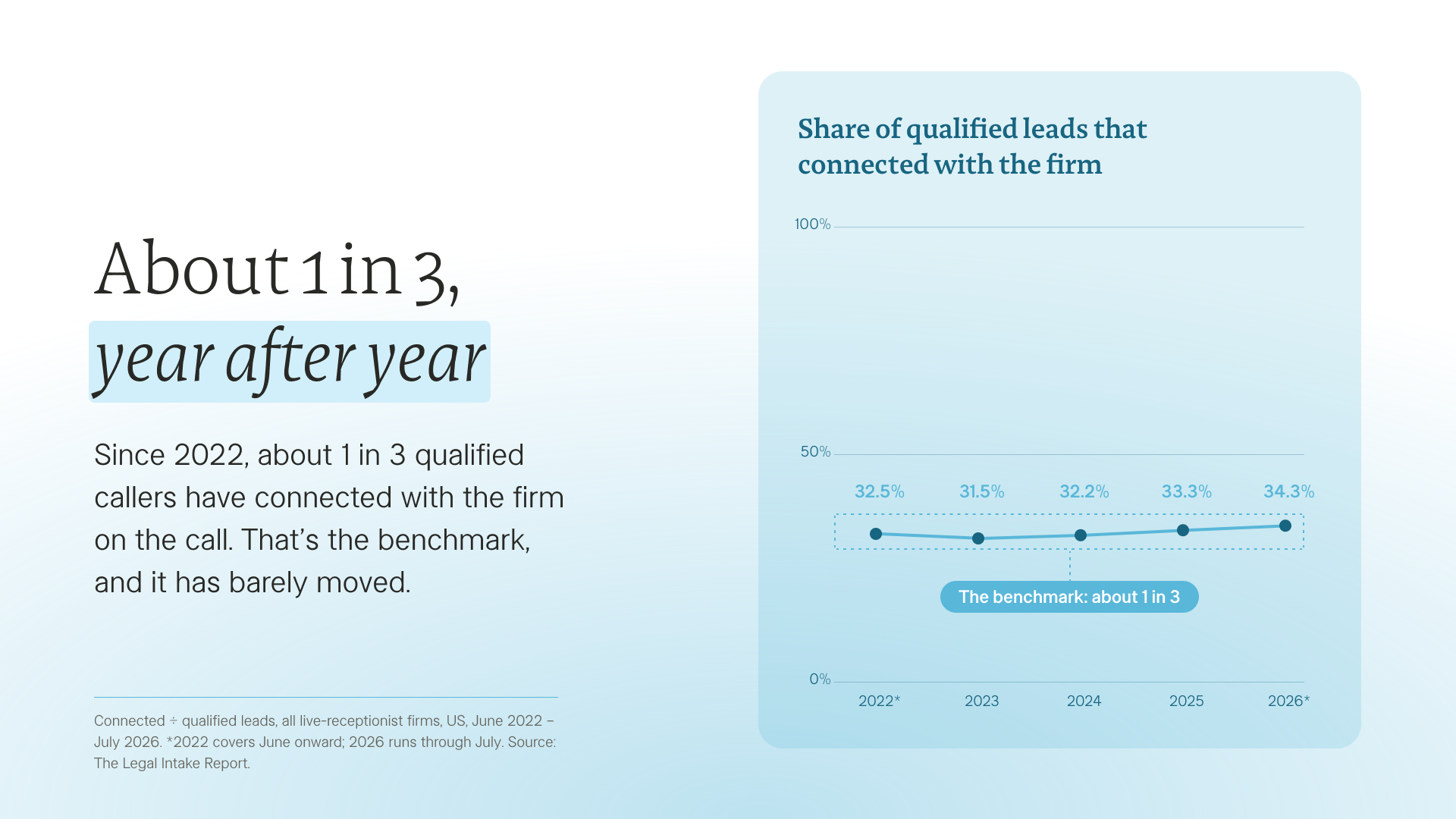
Smith.ai’s Legal Intake Report provides the industry's first public benchmark for intake connect rate, the law firm KPI that shows how many qualified callers actually reach your firm. Of 1,948,756 qualified leads who called US law firms from June 2022 to July 2026, 32.8% (about 1 in 3) connected with the firm on the call. That rate has held steady every year.
The key gaps highlighted by the report:
You're reading Part II of Inside the Legal Intake Report.
Have your number ready. In Part I of this series, we asked you to work out the law firm metric that matters most for intake: your connect rate.
Connect rate = qualified leads who booked a consultation or were transferred ÷ all qualified leads
If you haven't yet, start with Part I and its worksheet. You'll get more out of this post with your number in hand.
Before you compare, three things to know about the benchmark:
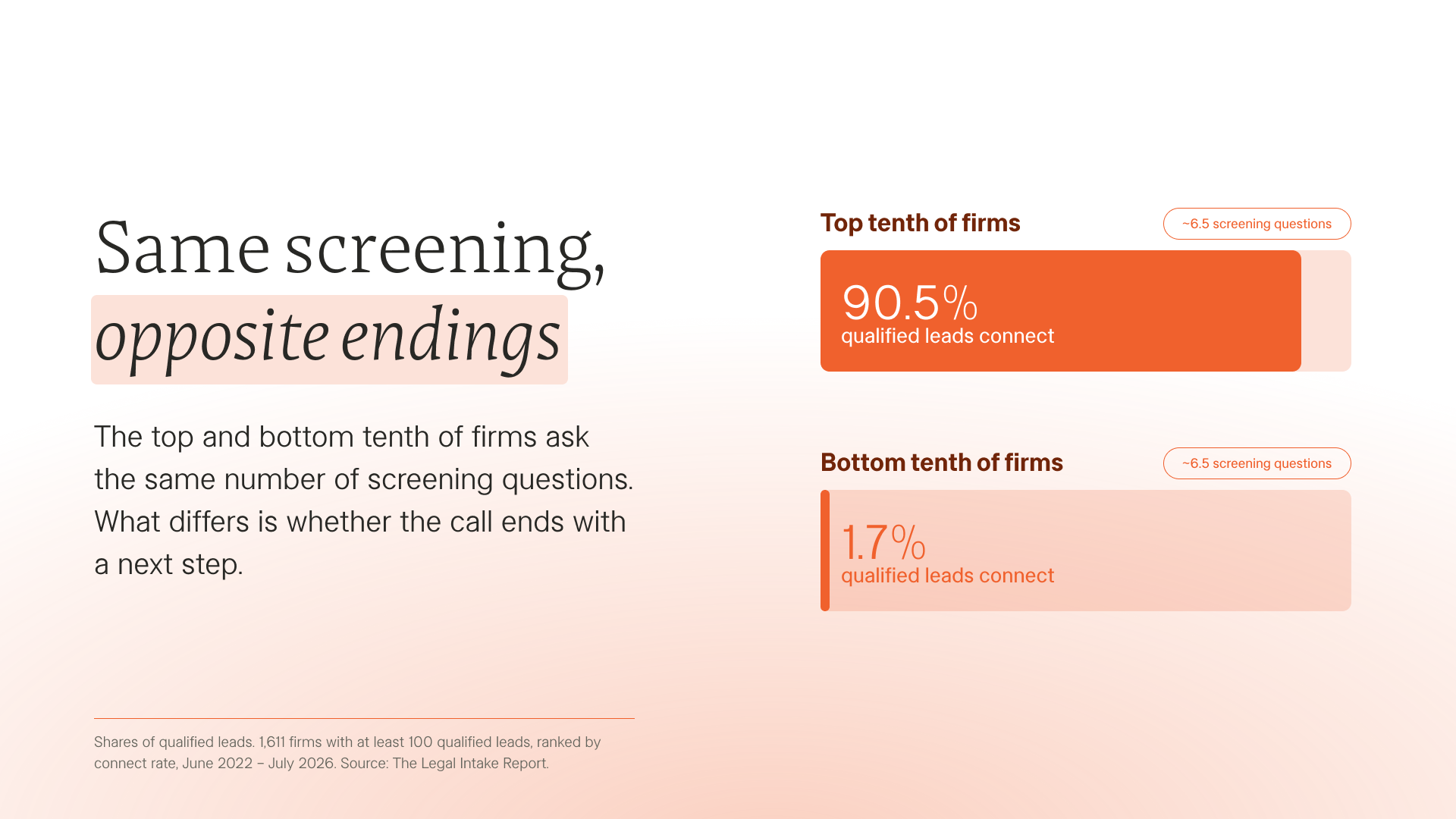
Among firms in the report with at least 100 qualified leads, more than a third connect fewer than 1 in 10 of those callers. About 15% connect more than 8 in 10. Which group a firm lands in comes down to how its calls end.
The “someone will call you back” firm: receptionists qualify every caller carefully, ask about 6.5 tailored intake questions, and end the call by just taking a message. Fewer than 2 in 100 qualified callers connect with these firms. At 509 firms in the report, none did.
The “let’s get you booked” firm: receptionists qualify callers and ask about the same number of questions. The difference is how the call ends: the receptionist offers a consultation time or transfers the caller to someone at the firm. These firms connect 9 in 10 qualified callers.
If your firm's calls usually end with "someone will call you back," you're likely closer to the bottom group than you'd want. The full report dives deeper into what the top tenth of firms have in common.
Give whoever answers your phone a way to book a consultation before the caller hangs up. In the report, firms whose live (human) receptionists were set up to book consultations, which the report calls scheduling enabled, connected 63.8% of qualified leads. Firms whose receptionists could only transfer the call connected 11.6%. The data comes from Smith.ai's receptionists, but the lesson applies to any front desk, in-house or outsourced.
Picture 100 qualified callers at each kind of firm:
The gap has held every year since 2022, yet 58% of firms using live receptionists haven't turned scheduling on.
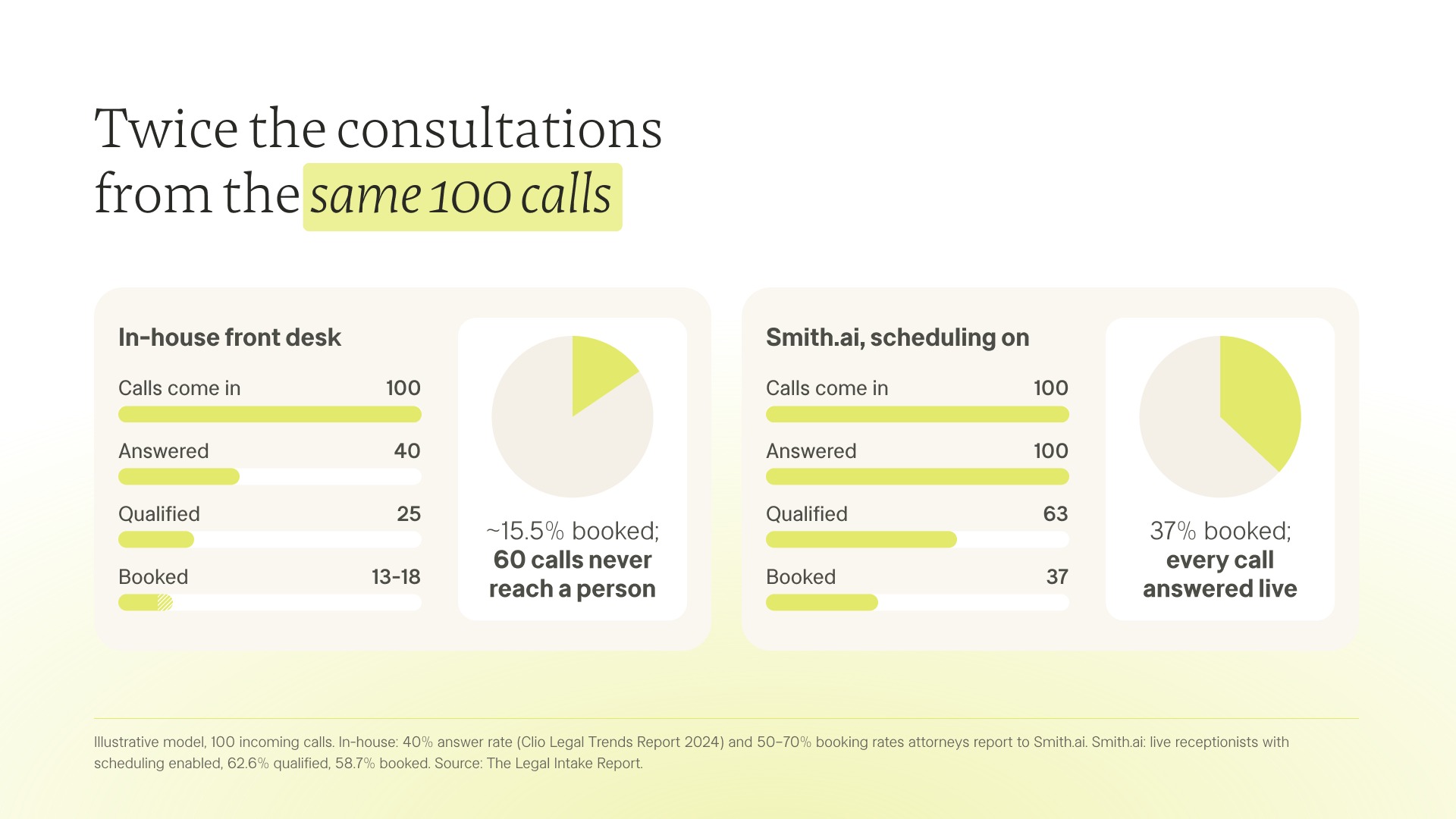
So far, we've only counted qualified callers. The report also models what the gap means across every call a firm gets. Take 100 incoming calls, booking at the 50-70% booking rates attorneys commonly report to Smith.ai:
That's roughly twice the consultations with no extra marketing spend and no new hires.
Nearly every firm owner has this objection ready. Some matters feel too urgent to book a week out. In some practice areas, callers want to talk price first. Those concerns are real, but a caller can't say yes to a consultation that's never offered, so the first fix is making sure the offer exists.
The data backs that up: in every practice area in the report, firms with scheduling enabled connect at least 30 points more of their qualified leads than firms without it.
Connect rates do vary by area. Across all firms, estate planning and bankruptcy connect about half of qualified leads, while personal injury connects about 1 in 5. But scheduling lifts every area. Personal injury, the area most often called unbookable, goes from 15.3% without scheduling to 69.3% with it.
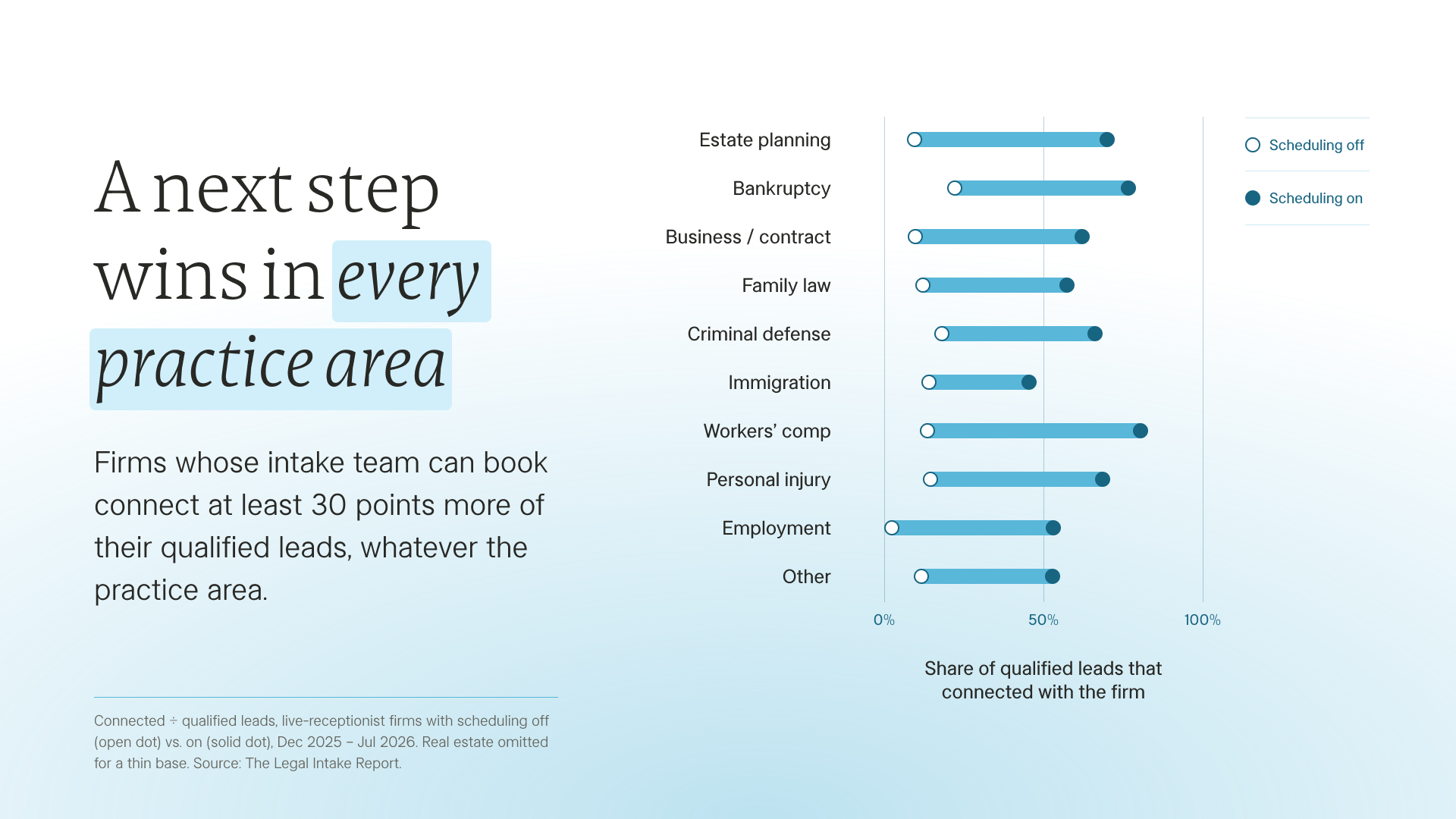
Practice area does shape how a call should end. Criminal defense and personal injury lean on transfers, because the caller may need a lawyer today. Estate planning books, because the caller can usually wait a week. Both routes count as a connection, and both are available to every firm.
The full report breaks out the numbers for each practice area.
The other common worry from firms that haven't turned on booking: what if the receptionist books someone who isn't a fit?
The screening criteria are yours. Your receptionists book only callers who meet the rules your firm sets, and booking a consultation is an administrative step, not legal advice. For more confidence in who lands on the calendar, add a few targeted screening questions (the county, the other party, key dates, what's already been filed) so your attorneys walk into every consultation prepared. We'll cover how many screening questions to ask, and what they do to your booking rate, in Part IV.
Those rules work the same whether a person or AI answers the phone. Next in the series, we look at what changes when AI takes the call, and how firms cover the hours when no one is at the desk.
Get the full Legal Intake Report for the breakdown by practice area, and what the top tenth of firms do differently.
Want a guided walkthrough of where your intake stands against the benchmark? Book a 15-minute intake review and we'll go through your numbers with you.
Next in the series: AI legal intake for law firms: finding the best setup

Danielle Whyte is a marketing coordinator at Smith.ai.


