Take the faster path to growth. Get Smith.ai today.
Affordable plans for every budget.


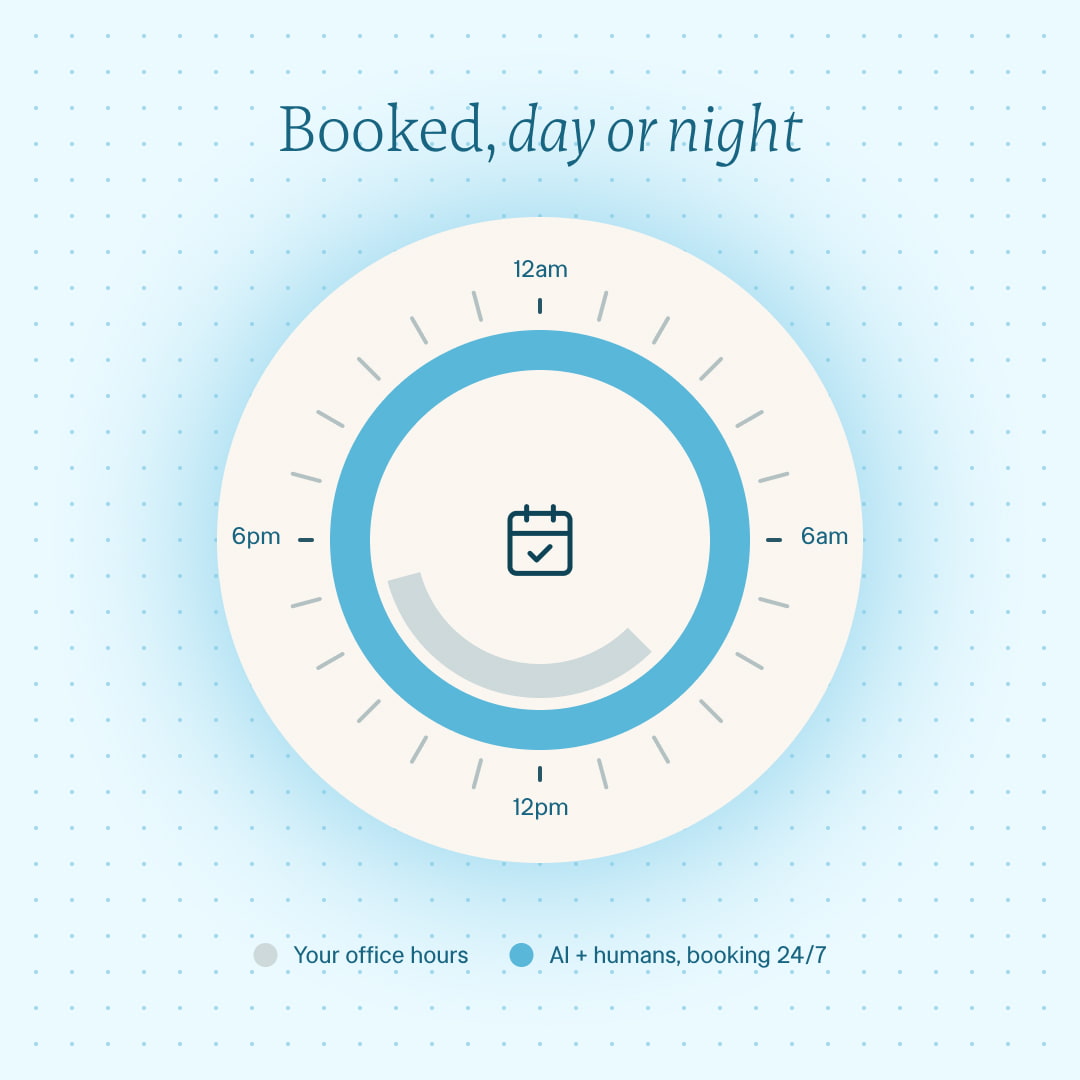
In Part II, we covered the one setting that separates top-performing firms from the rest: giving the intake team a way to book. This post covers what comes next: how to keep booking open around the clock, without adding more headcount.
Most firms frame intake as a choice: AI or people. The data says the best legal intake setup for law firms uses both: AI that answers every call and books into your calendar, with live receptionists stepping in when a caller needs a person.
More than 1 in 5 calls to live receptionists (22%) arrive outside the firm's business hours, and that share grew from 19.3% in 2022 to 23.8% in 2025. These callers qualify at nearly the same rate as daytime callers: 59.5%, against 63.7% during business hours.
That means these leads are just as likely to qualify and book as those that come in when your staff is present. What happens to them depends on your firm's intake setup.
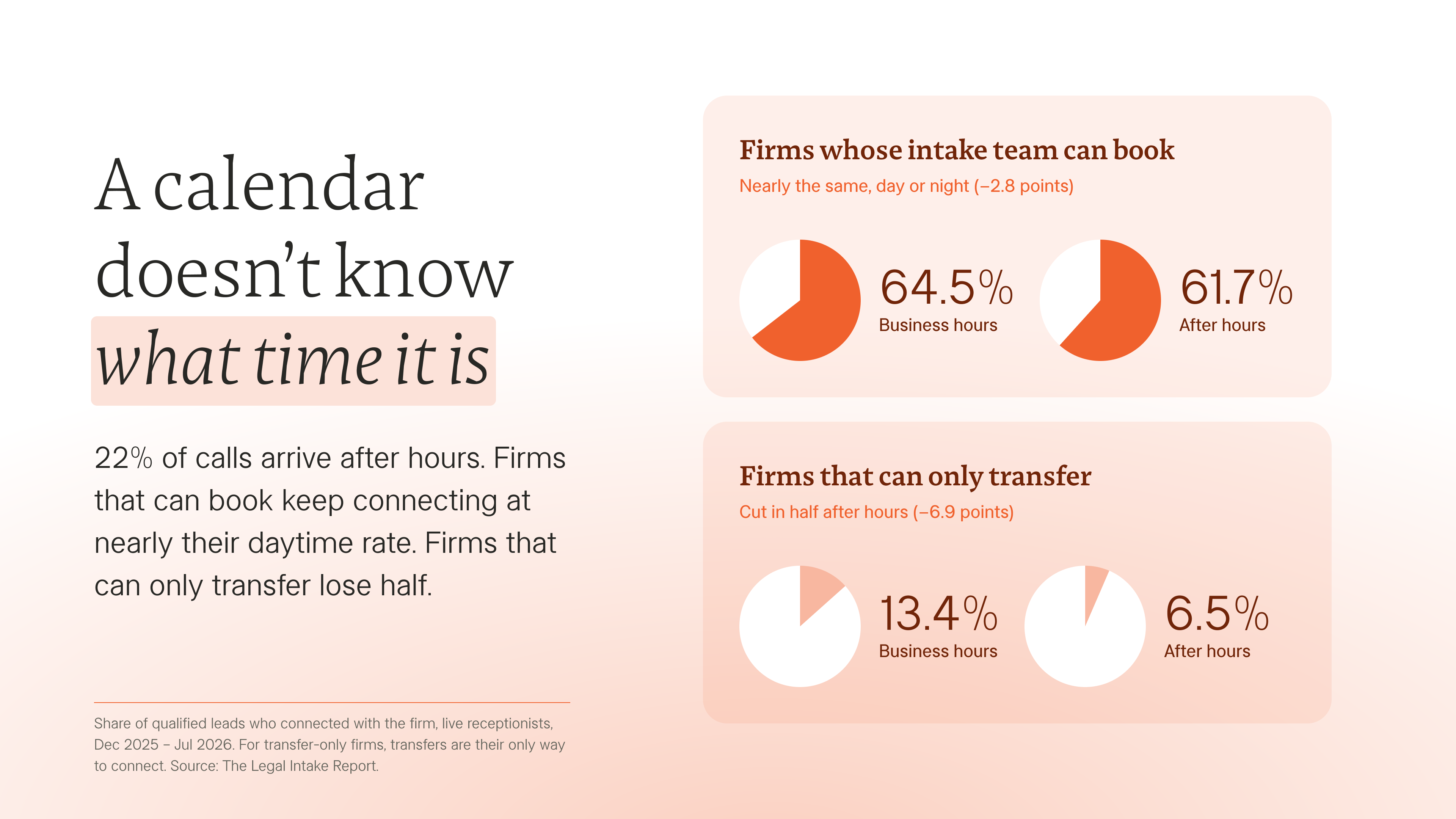
The bottom line: qualified callers don't stop calling when your office closes, so booking shouldn't stop either. The harder question is how to staff that, and it's where most firms reach for the wrong fix.
For most firm leaders, the first fix that comes to mind is hiring another person to answer the phones. Here’s the math:
And even full coverage has a ceiling, because one person can take only one call at a time. Across 3.1 million live-receptionist calls, 8.1% arrived while another call at the same firm was still in progress, and the report treats that as a floor. A longer shift doesn't help the second caller who reaches voicemail at 2 p.m.
The firms connecting six in ten qualified leads aren't running in-house receptionists 24/7. They outsource, pairing legal intake automation with live receptionists, so whoever answers the phone can book at any time, and the second caller doesn't have to wait for the first call to end.
Between December 2025 and July 2026, at the 157 law firms using Smith.ai's AI Receptionist with scheduling enabled, 42.2% of qualified leads booked a consultation.
Look at the breakdown of booking rates by how the call was handled:
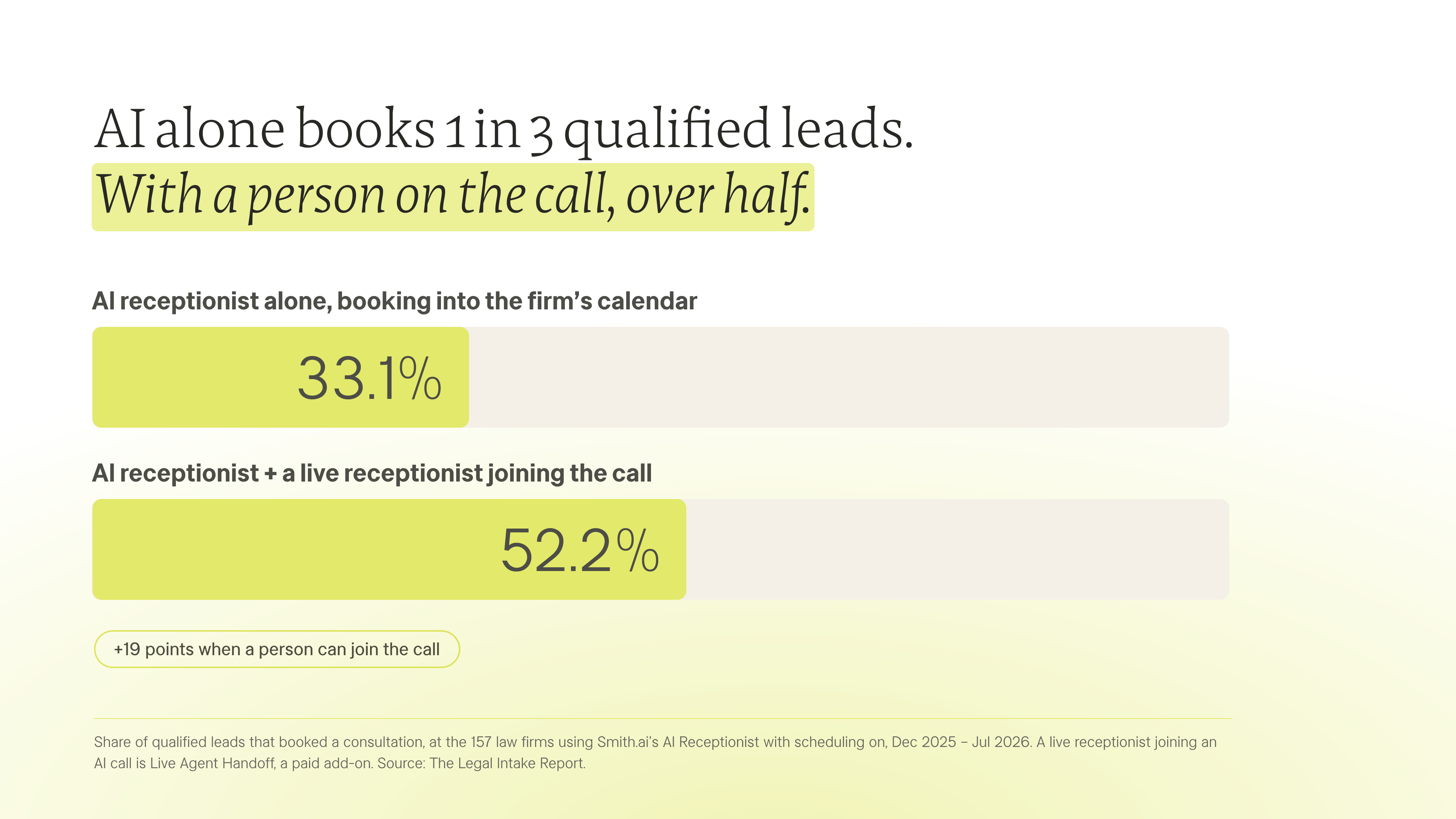
Most firms we analyzed using Smith.ai's AI Receptionist haven't turned on scheduling: 261 of the 418 with qualified leads in the period. That's why, across all 418 firms, only 12.8% of qualified leads reached the firm, against 42.2% at the 157 firms whose AI can book.
Closing that gap comes down to two setup pieces: a calendar the AI can book into and a live receptionist who can step in when a caller needs a person or the AI needs human assistance.
At AI receptionist firms with scheduling enabled, a live receptionist joined 2 in 3 qualified AI calls (67%). Here's what brought them in:
The firm controls every one of these choices: which callers go to a person, whether the AI books, and what it does at the end of a qualified call.
This is how Smith.ai’s hybrid AI and human receptionists work: AI answers every call and books around the clock, and live receptionists step in when a caller needs a person. You keep booking 24/7 without staffing every hour.
In the last post, we ran 100 incoming calls through a typical law firm front desk: 40 answered, about 25 qualified, and only 13 to 18 consultations booked.
Run the same 100 calls against our AI Receptionist and hybrid intake setups, and every call gets answered. About 63 callers qualify, in line with the 62.6% qualification rate across the report.
The Legal Intake Report found that AI alone (intake where the AI handles the call from start to finish) beats the top of the in-house booking range, and the hybrid setup roughly doubles it.
The trade-off: hybrid intake books 6.5 points fewer qualified leads than live receptionists alone (52.2% vs. 58.7%), but at less than half the cost of a human-only service.
Transfers have a place, especially for urgent matters where a caller may need a lawyer today. But a transfer is a bet that someone at the firm is free at that moment, and two in three transfer attempts don't reach anyone.
The fix is one additional line in your intake instructions: if the transfer doesn't connect, offer an appointment. When the receptionist offered one, 77.1% of those callers booked, and firms that build this transfer-then-book step into their intake connect 63.4% of qualified leads.
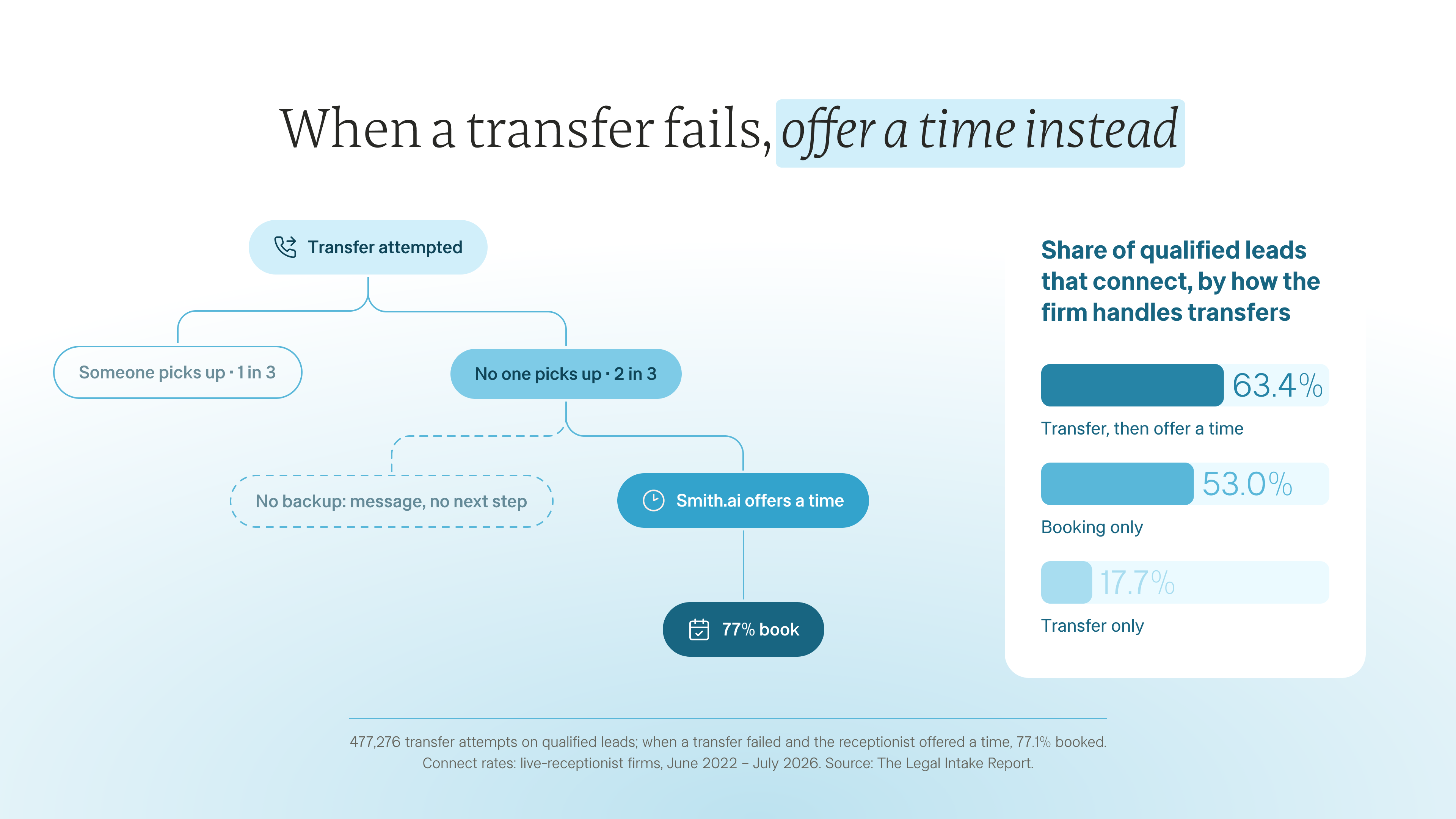
A transfer needs someone at the firm to be available. A booked consultation just needs a connected calendar.
In Part II of this series, you gave your intake team a way to book. Here's how to keep that offer open around the clock, no matter who answers the phone.
Get the full Legal Intake Report for more data on the AI-plus-human mix.
Want to see what AI intake for law firms looks like with human backup? Book a 15-minute intake review with our team.
Next in the series: With booking offered 24/7, the next question is what happens when a qualified caller hesitates. In Part IV, we’ll look at how to tune your intake script so more qualified leads say yes.

Danielle Whyte is a marketing coordinator at Smith.ai.


