Take the faster path to growth. Get Smith.ai today.
Affordable plans for every budget.


Key numbers
Updated October 2026
A legal intake specialist is the person at a law firm who answers new-client calls, screens each caller, and books the consultation, and one full-time hire covers about 40 of the 168 hours in a week, according to the illustrative staffing math in the Smith.ai Legal Intake Report. Staffing every hour with employees, at an illustrative $50,000 a year per hire, comes to $210,000 a year. For most firms the better answer is both: a specialist for the work that needs someone inside the firm, and outsourced intake for every hour and every call that person can't take.
The report draws on 3.2 million answered new-business calls to 4,210 U.S. law firms from June 2022 through July 2026. Here is what it says about the hiring decision.
An intake specialist is the firm's first point of contact for prospective clients: they answer new-business calls, decide whether the matter fits the firm, gather the facts an attorney needs, and set the next step. Firms also call the role intake coordinator or legal intake specialist. In a small practice it is often a paralegal or office manager doing it between other work.
The screening part of the job is more exacting than it sounds. The report describes four jobs a good screening question does:
Then the specialist books the consultation or transfers the caller to an attorney, and enters everything into the firm's CRM. In the report, a call with a qualified lead runs a median 6.0 minutes and about 16 steps, of which six and a half are screening questions. The rest is contact capture and internal workflow the caller never hears.
In the report's illustrative model, one full-time hire at $50,000 a year covers about 40 of the week's 168 hours, and covering all 168 with employees costs $210,000 a year. The report labels both the salary and the hours as assumptions, so treat them as a frame for the decision and plug in pay rates from your own market.
The hours matter because new clients don't call on office time. 22% of calls to live receptionists in the report arrived outside the firm's declared business hours, and that share grew from 19.3% in 2022 to 23.8% in 2025. A specialist who works the firm's business hours isn't there for any of those calls.
Sick days, vacation, and turnover reopen the gap too, and each new hire has to learn your screening questions and practice areas from scratch.
No, not even during business hours. Across 3.1 million calls since June 2022, 8.1% arrived while another call at the same firm was still in progress, and the report treats that figure as a floor. One person takes one call. In the report's words, "The second caller waits, reaches voicemail, or hangs up, at 2pm as at 9pm, and a longer shift solves neither."
The specialist also isn't at the phone all day. Consultation prep, callbacks, conflict checks, and data entry all take them off the line, and every one of those minutes is a chance for a new caller to land in voicemail. Across the profession, that is the common outcome: Clio's 2024 secret-shopper study of 500 U.S. firms, cited in the report, found that 40% answered the phone and 48% could not be reached by phone at all, even after call-back attempts.
Conversion depends less on who answers than on two things the firm controls: whether every call gets answered, and whether the person answering can book. The report's illustrative model runs the same 100 callers through both setups.
What 100 calls are worth: illustrative model from the Smith.ai Legal Intake Report
The in-house column uses Clio's 40% answer rate and the 50–70% booking rates attorneys commonly report to Smith.ai for their own intake. The second column uses the report's 62.6% qualified share and 58.7% booking rate at firms with scheduling enabled. Rounded to whole callers.
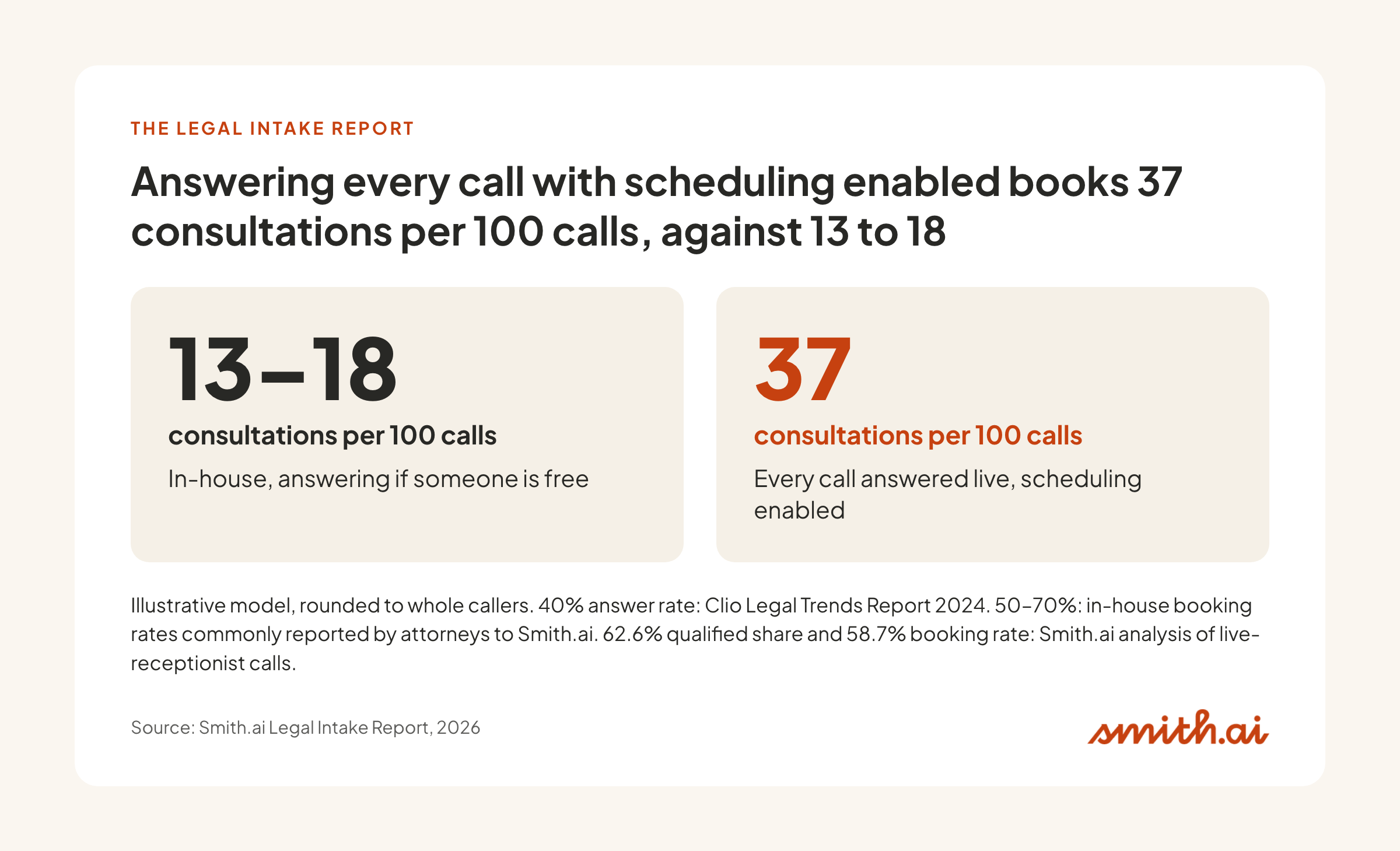
Read the table carefully. The in-house team books well on the calls it answers. It loses on the 60 calls nobody picks up. Answer all 100 and book at 58.7%, and 13 to 18 consultations become 37.
Booking is the other half. With scheduling enabled, 63.8% of qualified leads connected with the firm; without it, 11.6% were transferred and that was the whole result. The report's conclusion on hiring: "The gap this report measures does not cost $210,000 a year to close."
An in-house specialist brings knowledge of your clients and cases; outsourced intake brings coverage of every hour and every simultaneous call. The two fit together better than they compete.
In-house intake specialist vs. outsourced legal intake
Treat outsourced intake as an extension of your intake team: it answers every call, and your specialist does the work that needs someone inside the firm. A split that works for many firms:
Then hold both sides to the same numbers. The report names three to know by heart, each stated against qualified leads: booking rate, transfer rate, and connect-to-firm rate. Across all firms, live receptionists booked 24.2% of qualified leads and connected 32.8%; firms with scheduling enabled reached 58.7% booked and 63.8% connected. Quote a rate against every answered call instead and it reads about a third smaller, so always say which denominator you mean.
Smith.ai is end-to-end intake for law firms, run by AI + humans. More than 5,000 law firms use it, and it has handled 25M+ calls since 2015. The AI Receptionist picks up every call, including simultaneous ones, and books on its own where it has a calendar it can write into. Smith.ai's Virtual Receptionists, 500+ North America-based live agents, many of them former paralegals and court staff, take the calls that need judgment and can join an AI call mid-conversation. Run them together in a hybrid AI + human setup, turn on appointment booking, and sync every intake to Clio, Lawmatics, or MyCase.
Smith.ai charges per call, not per minute. Compare AI Receptionist pricing and Virtual Receptionist pricing against the cost of your next hire, see the Smith.ai legal intake overview, or check intake conversion rates by practice area. The full Legal Intake Report has the data and methodology behind every number here.