Take the faster path to growth. Get Smith.ai today.
Affordable plans for every budget.



When firms are asked to change how their phones are answered, the same objections tend to come up: the leads are junk, booking doesn’t work in our practice area, callers just want a price. This post sets six of those beliefs against 3.2 million answered calls from the Legal Intake Report, then gives you five fixes you can make without hiring anyone.
When firm owners are asked to change their intake, the same six objections come up. Here's each one, set against what 3.2 million answered calls from the Legal Intake Report show. "Connect" means the caller booked a consultation or was put through to someone at the firm.
Truth: 62.6% of answered calls to live receptionists qualify as leads under the firm's own criteria, and that share has held steady every year. Whether those callers reach the firm depends on the firm's phone setup, not on who's calling. (Covered in Part I.)
Truth: In every practice area, firms that book on the call connect with at least 30 more of every 100 qualified callers than firms that don’t. In personal injury, the area most often called unbookable, it's 69.3% against 15.3%. (Covered in Part II.)
Truth: 22% of calls to live receptionists arrive after hours. Firms that book on the call connect 61.7% of those qualified leads, close to their 64.5% during business hours. Firms that rely only on transfers put through 13.4% of qualified callers during the day and just 6.5% after hours, because at 9 p.m., nobody at the firm picks up. (Covered in Part III.)
Truth: When it can book straight into your calendar, an AI receptionist books 33.1% of qualified leads on its own, with no person on the call. The bigger number comes from an AI-led, human-backed setup: when a live receptionist joins the AI's call to complete the booking, 52.2% book. So if your AI receptionist isn't booking, or you're on the fence about getting one, the question isn't whether AI can book. It's how it's set up: connect the AI to a calendar it can add appointments to, and have a live receptionist ready to join and finish the booking on the calls you choose. (Covered in Part III.)
Truth: Outside family law, price came up in fewer than 1 in 5 cases where a caller turned down a consultation and said why (17.9%). In family law, it was about 3 in 10 (28.7%). Charging for the consultation can lower bookings, but firms that charge still book, and what you control is how the fee is handled on the call: state it up front, keep offering a time, and use screening questions to spot callers with a deadline, who are less likely to balk at a fee. (Covered in Part IV.)
Truth: Qualified leads who were asked seven to nine screening questions book a consultation 29.9% of the time, against 22.4% at three or four. The extra questions add under a minute to the call, and your attorney walks into a better-prepared consultation. (Covered in Part IV.)
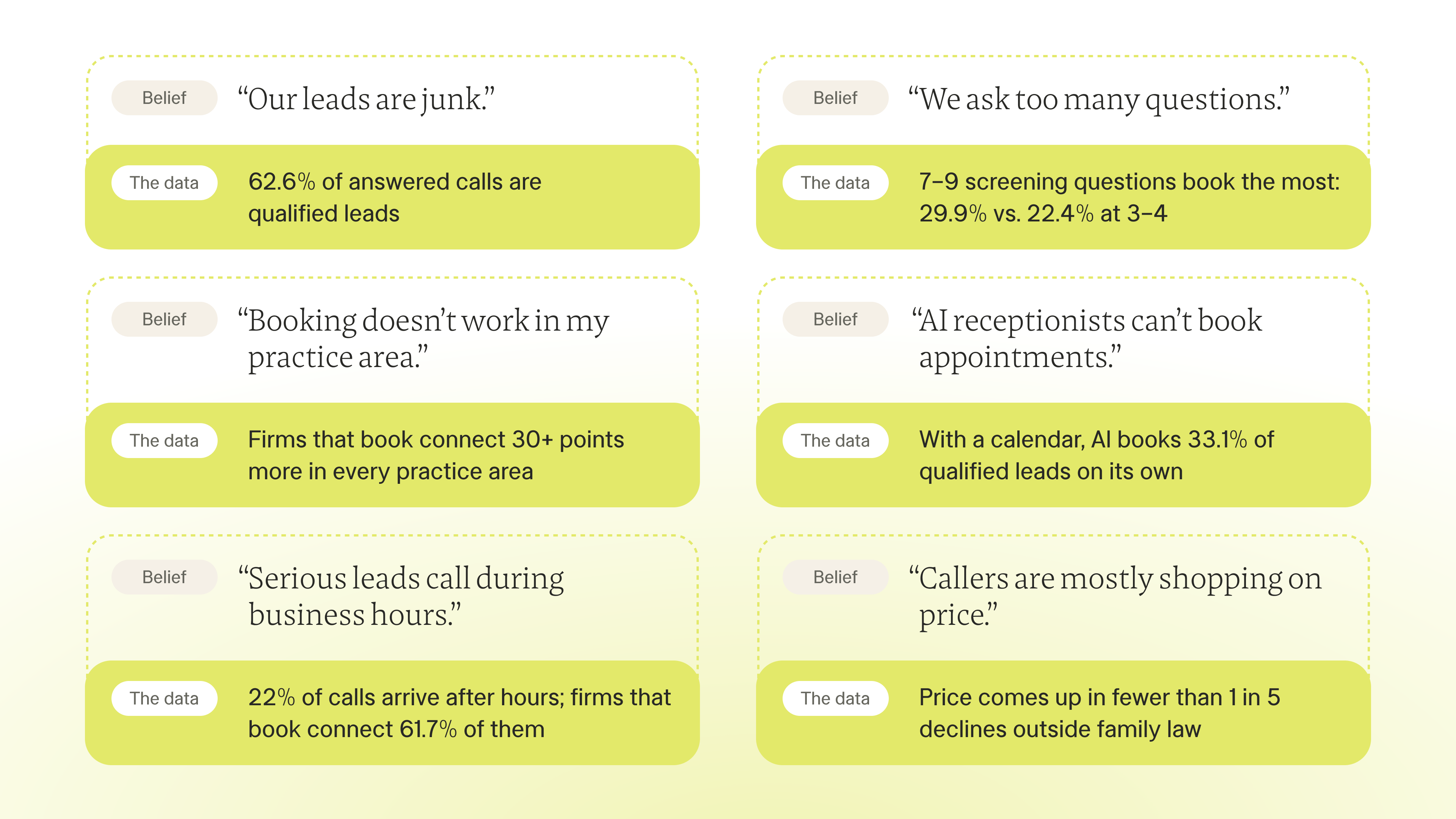
Each belief puts the problem outside the firm: in the callers, the practice area, the hour, or the technology. The data keeps pointing back to the intake instructions, which the firm controls.
"The prospective clients are already calling. Whether they reach you is a set of instructions to whoever answers your phone, and those instructions are yours to write." —The Legal Intake Report
None of these requires hiring, switching systems, or a change to how you practice law. Each one is an instruction to whoever answers your phone.
Five fixes for your law firm intake
Make these changes
If you filled out the worksheet in Part I, you already have number five.
Every number in the report comes from calls law firms were already receiving, and already paying to generate. Nothing here or in the report asks a firm to buy more leads or hire more people. The gap sits between the call arriving and the firm deciding what its intake team should do with it.
Closing the gap comes down to two things:
That's what Smith.ai's AI and live receptionists do for law firms: answer every call around the clock, ask your screening questions the same way every time, and book qualified callers straight into your calendar.
Get the full Legal Intake Report for every finding, the breakdowns by practice area, and the screening questions for 15 practice areas.
Want help putting these fixes in place at your firm? Book a 15-minute intake review with our team.
That's a wrap on Inside the Legal Intake Report. Catch up on the full series:

Danielle Whyte is a marketing coordinator at Smith.ai.


