Take the faster path to growth. Get Smith.ai today.
Affordable plans for every budget.


Key numbers
Updated October 2026
When a law firm's live transfer fails, the caller usually leaves a message, and most transfers do fail: of 477,276 transfer attempts on qualified leads in the Smith.ai Legal Intake Report, 33.7% reached someone at the firm. Firms whose intake instructions offer a booking when the transfer fails connect 63.4% of qualified leads. Firms that only transfer connect 17.7%.
The report draws on 3.2 million answered new-business calls to 4,210 U.S. law firms from June 2022 through July 2026, each picked up live by a Smith.ai human or AI receptionist working from the firm's own intake instructions. This post is about one line in those instructions: what the receptionist does after "let me put you through."
A live transfer puts a qualified caller straight through to someone at the firm while the call is still happening, usually an attorney and occasionally a member of the intake team. The report keeps the definition strict. A call passed to a Smith.ai receptionist is a handoff, never a transfer. A transfer has to reach the firm.
Firms transfer for good reasons. Someone whose brother was arrested last night, or who was rear-ended this morning, may need a lawyer today, and the report notes that criminal defense and personal injury lean on transfers for exactly that reason. Across the dataset, personal injury calls end in a transfer for 13.4% of qualified leads and a booking for 7.2%. In criminal defense it's 15.3% transferred and 19.8% booked.
About one time in three. Across 477,276 transfer attempts on qualified leads, 33.7% reached someone at the firm. The other two in three ended with the office not answering or declining to take the call.
The report frames it as a wager: "a transfer is a bet that someone at the firm is free right now." Attorneys are in hearings, on other calls, with clients, or gone for the day. After hours the odds drop further; at firms without scheduling enabled, transfers fall from 13.4% of qualified leads in business hours to 6.5% outside them.
At a transfer-only firm, nothing catches the caller who wasn't put through. In the report's words, "A caller who was not put through and had no appointment to take leaves a message, and the firm starts the next morning where the call ended."
Transfer-then-book means the receptionist attempts the transfer and, if no one picks up, offers the caller a consultation on the firm's calendar instead of taking a message. In the firm's instructions it is a single line: if the transfer does not connect, offer an appointment.
The report puts a firm in this group when it had at least ten failed transfers and its receptionist offered a booking after at least a quarter of them. That comes to 295 firms and 282,249 qualified leads. When their transfer failed and a time was offered, 77.1% of those callers booked it. Those recovered bookings add up to 15.7% of the group's qualified leads and 24.8% of everything the group connects.
The fallback costs the firm nothing on the call. The after-hours caller, the lunchtime caller, and the caller who rang during a hearing all hang up with a time on the firm's calendar.
Transfer-then-book firms connect more qualified leads than any other intake design in the report: 63.4%, against 53.0% at booking-only firms and 17.7% at transfer-only firms. "Connect" means the caller booked a consultation or was transferred to the firm, counted once.
Connect rate by intake design, share of qualified leads (live-receptionist calls, June 2022 to July 2026)
Source: Smith.ai Legal Intake Report, 2026. Firms are grouped by what their own intake team does across their calls.
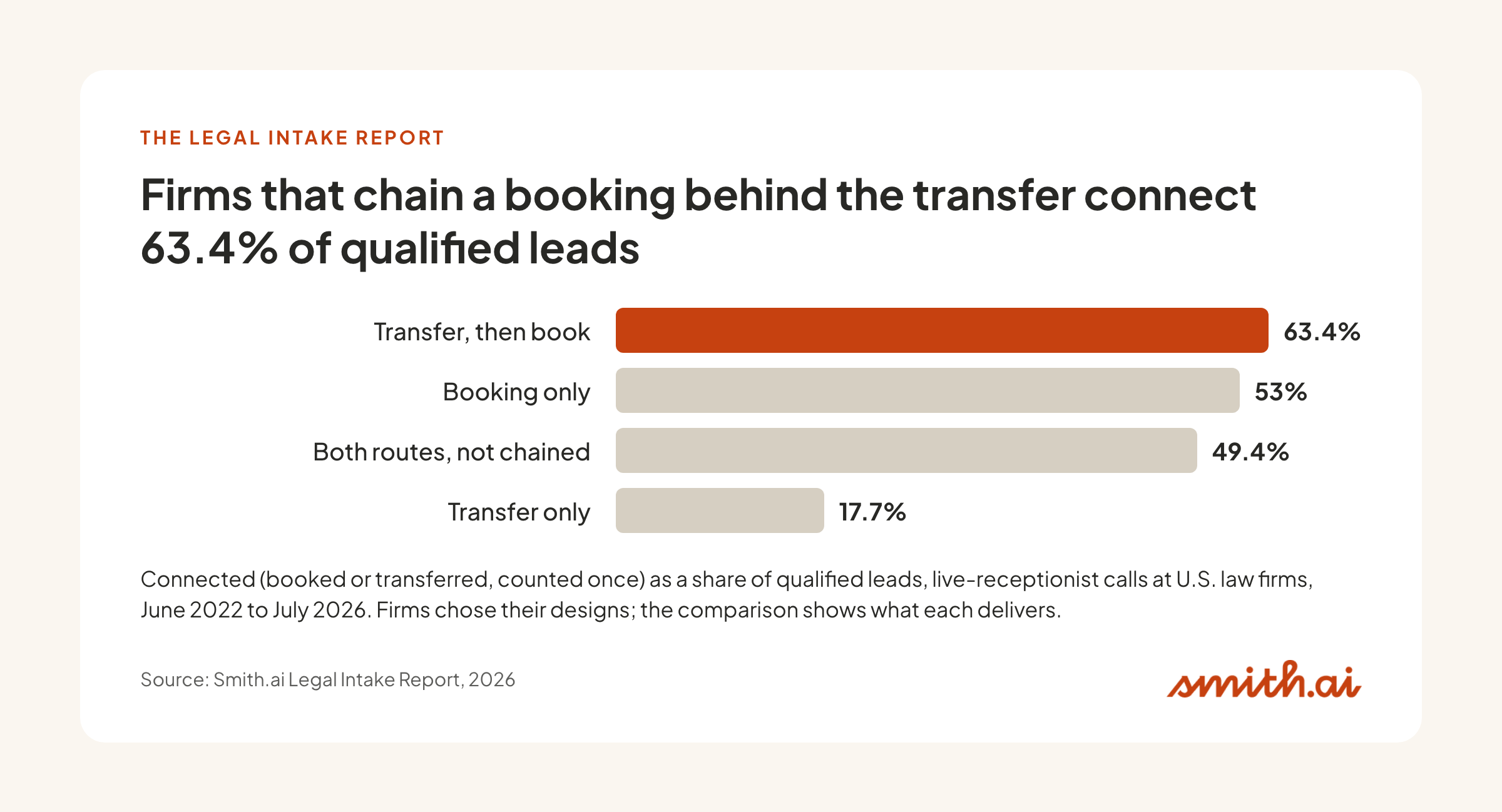
Look at the third row. Firms that both book and transfer, but not in sequence, connect 49.4%, a little below the booking-only group. Offering both routes on paper isn't what moves the number. The gain appears when the booking offer is wired to the failed transfer, so the second route catches the caller the first one dropped.
The top of the ranking tells the same story. Among 1,611 firms with at least 100 qualified leads, the top tenth connect 90.5% of them, and 27% of those top-tenth firms offer a booking after a failed transfer. Firms chose their own setups, so all of these gaps describe what each design delivers for the firms that run it, not the result of a controlled test.
Because these firms don't transfer everyone. Their instructions send particular callers, matter types, or after-hours calls straight to booking, and those calls book well on their own. The 63.4% covers every qualified lead at these firms, whichever path the call took.
So the design question is bigger than the fallback line. A firm decides which callers are worth an immediate attempt at an attorney, and everyone else gets a consultation offer. Smith.ai's account build guide for law firms (August 2026), published in the report, recommends an end-of-call action by practice area:
Practice area shapes how the call should end. It doesn't decide whether the firm gets the client. For connect rates in your field, see law firm intake conversion rates by practice area.
For a qualified lead, a message is the ending with the weakest record in the data. Among 2,120 firms with at least 100 qualified leads, 509 connected none of them. Their intake team screened each caller, recorded a fit, took a message, and ended the call. That is 424,046 qualified leads, every one judged worth having.
The report's verdict is short: "Message-only intake instructions are a choice, too." It is also clear about what it can't see. The dataset doesn't count clients won later from a message and a callback, so some of those callers may have signed eventually. But leads are hard to reach by callback, which is why the report concludes that how a lead is handled on the first inbound call determines whether that lead ever converts.
None of this applies to every call a firm gets. The report measures new-business calls only, and existing-client calls are excluded. For a vendor or a current client, a message may be exactly right.
Smith.ai runs end-to-end intake for law firms, run by AI + humans: it answers the call, qualifies the caller against your criteria, attempts the transfer under your rules, books the consultation when the transfer fails, and logs the outcome in your practice management system. Setup comes down to four decisions.
The same end-of-call rules apply to the AI Receptionist and to Smith.ai's Virtual Receptionists, and firms can run both together in a hybrid AI + human setup. The AI books on its own where it has a calendar it can write into, and a live agent joins to finish the booking where it doesn't. More than 5,000 law firms use Smith.ai, which has handled 25M+ calls since 2015 with 500+ North America-based live agents.
See how it works for your practice on the Smith.ai legal intake page, compare Virtual Receptionist pricing and AI Receptionist pricing, or read the full Legal Intake Report for the methodology behind these numbers.