Take the faster path to growth. Get Smith.ai today.
Affordable plans for every budget.


Key numbers
Source: Smith.ai Legal Intake Report, 2026
Updated October 2026
Immigration law firms connect 28.7% of qualified leads to the firm on the first call, by booking a consultation or transferring the caller to someone at the firm, according to Smith.ai's Legal Intake Report, an analysis of 3.2 million answered calls to 4,210 U.S. law firms. Firms that let their intake team book consultations connect 46.1%. Firms that don't connect 14.7%.
This post covers the immigration numbers, six of the screening questions Smith.ai recommends for immigration calls, and how the call should end when the caller, or the person they're calling about, is detained.
Immigration firms convert 28.7% of qualified leads during the call: 23.6% book a consultation and 5.1% are transferred to the firm. The report calls this the connect-to-firm rate, and it counts each caller once. A qualified lead is a caller the receptionist, human or AI, judged to be a viable prospective client under the firm's own criteria.
The denominator matters when you compare your own numbers. Across live-receptionist calls, 62.6% of answered new-business calls are qualified leads, so a conversion rate measured against every call will read lower than one measured against qualified leads. Check which one your intake reports use before you compare them with these benchmarks.
That puts immigration in the middle of the practice-area table. It sits below family law (37.8%) and criminal defense (35.1%), and above personal injury (20.6%). Across all practice areas, live receptionists connect 32.8% of qualified leads. You can see every area side by side in our intake conversion benchmarks by practice area.
Immigration intake benchmarks, shares of qualified leads
Source: Smith.ai Legal Intake Report, 2026. All-firm rates cover live-receptionist calls June 2022 to July 2026 and AI receptionist calls from December 2025, with practice area read from what the caller said the matter was. The scheduling split covers live-receptionist firms, December 2025 to July 2026.
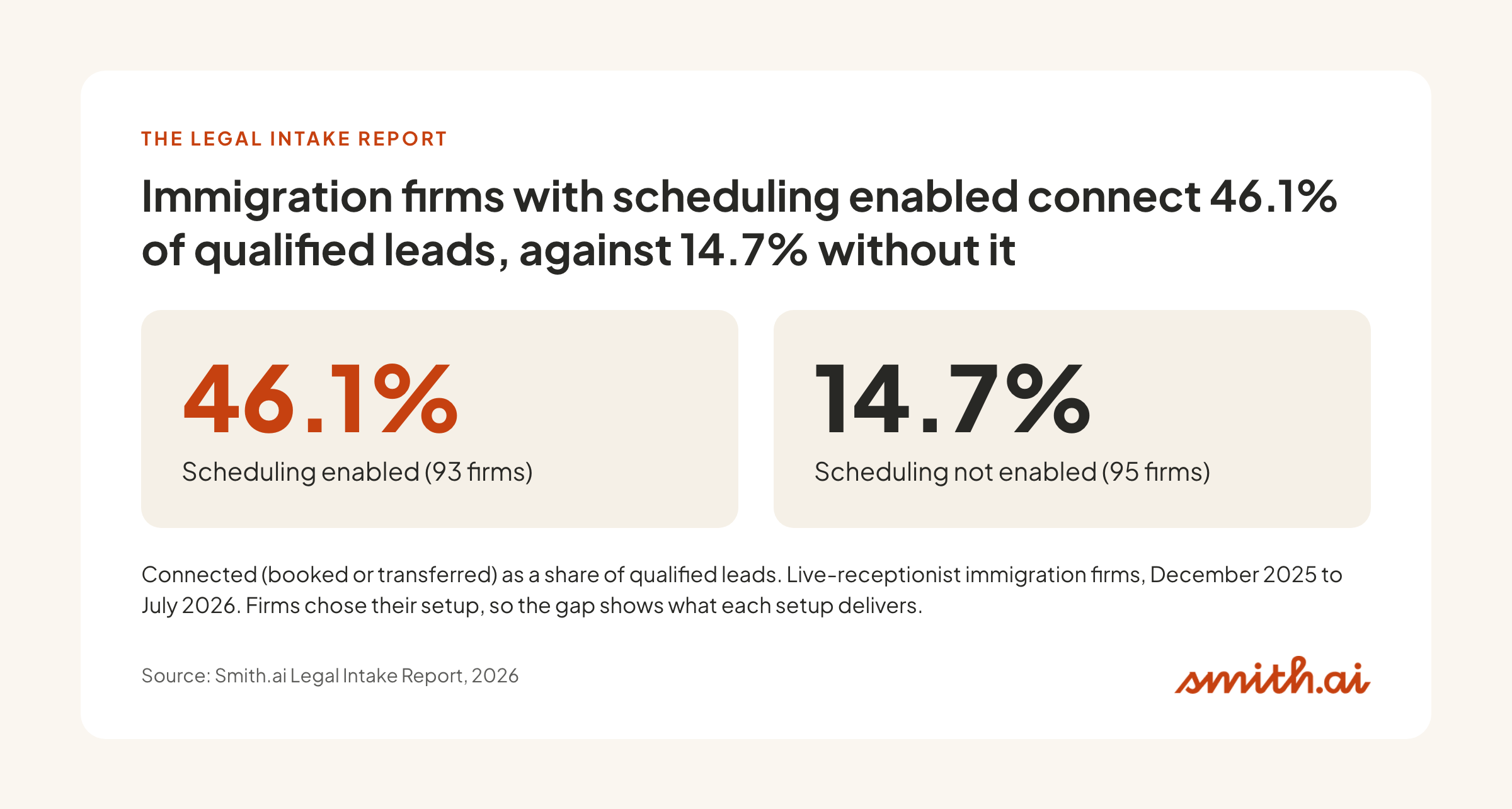
Immigration firms with scheduling enabled connect 46.1% of qualified leads, 31.4 points more than the 14.7% at firms without it. "Scheduling enabled" means the firm has asked its receptionists to book consultations for qualified callers.
That 31.4-point gap is the narrowest of any practice area in the report. It still clears the report's floor: in every area, firms with scheduling enabled sit at least thirty points above firms without it. Firms chose their own setups, so the gap shows what each setup delivers for the firms that run it rather than a guaranteed result from flipping the switch.
The mechanism is simple. Without a booking option, the receptionist's only good ending is a transfer, and a transfer needs someone at the firm free to pick up. Across all practice areas, 33.7% of transfer attempts on qualified leads reached someone at the firm.
An immigration intake should ask about detention first, then ICE involvement and upcoming hearings, because those answers decide how the call ends. Smith.ai's account build guide for law firms (August 2026) has nine immigration screening questions. Six of them:
Sample immigration intake questions
Source: Smith.ai account build guide for law firms, August 2026, as published in the Legal Intake Report. The question set applies to live and AI receptionists alike.
The first question is phrased for two callers at once. Many immigration calls come from a spouse, parent, or friend calling about someone who is already in custody, and the intake has to work either way.
Question 2 matters more than it looks. If the prospective client is detained, the firm needs a reachable contact who isn't, or there's nobody to call back.
Questions 3 and 4 fix what has already happened and when the next date falls. The report describes the four jobs a screening question does: it fixes a date, fixes a place, names the other party for a conflict check, and records what has already happened. In immigration, the date is usually a hearing or filing deadline, and the place is often a detention facility.
Question 5 tells the attorney where the conversation starts. Current status shapes which options exist, and having it written down before the consultation means the meeting opens on substance instead of paperwork.
Question 6 branches the script. A family petition, an asylum matter, and a removal defense case need different follow-ups, so the matter type decides which questions come next. The full set adds three questions on the caller's documents and history in the U.S. Those are in the full report, along with the question sets for every other practice area in the guide.
It depends on urgency. Smith.ai's guide recommends "urgent: transfer first, schedule if no one answers; otherwise: schedule" for immigration calls. The report groups immigration with probate as areas where "a detained caller or a disputed estate can need a lawyer today."
The firm defines urgent. Detention, ICE involvement, and a hearing in the next few days are the obvious triggers, and the first four questions surface all three before the call is half over. For those callers, the receptionist tries to put the call through to an attorney. If no one answers, the receptionist books the consultation on the spot instead of taking a message.
That second step is worth writing into your intake instructions. Across all practice areas, firms whose instructions offer a booking after a failed transfer connect 63.4% of qualified leads, against 17.7% for firms that only transfer. And 77.1% of callers offered an appointment after a failed transfer take it.
Everyone else gets a booked consultation. That's already how most immigration connections happen: 23.6% of qualified leads book, and 5.1% are transferred.
Smith.ai runs end-to-end intake for law firms: it answers every call, asks your immigration question set, books qualified callers onto your calendar, attempts a transfer when your rules call for one, and sends the intake record to your practice management software. More than 5,000 law firms use it, and it has handled more than 25 million calls since 2015.
You choose the mix. An AI Receptionist handles routine calls, and with AI + human receptionists a live agent can join any call that needs a person, such as a frightened relative describing an arrest. Firms that want people on every call use our Virtual Receptionists, a team of 500+ North America-based live agents, many of them former paralegals.
Consultations go straight onto the firm's calendar through appointment booking, and intake answers sync to Clio, MyCase, and Lawmatics, so the attorney opens the consultation already knowing the detention status, the hearing date, and the matter type. Per-call pricing is on the AI Receptionist pricing page.
For the full immigration question set and the scheduling breakdown for every practice area, download the Legal Intake Report.