Take the faster path to growth. Get Smith.ai today.
Affordable plans for every budget.



Key numbers
Source: Smith.ai Legal Intake Report, 2026
Updated October 2026
Estate planning firms connect 50.7% of qualified leads to the firm on the first call, the highest rate of any practice area in Smith.ai's Legal Intake Report, an analysis of 3.2 million answered calls to 4,210 U.S. law firms. Most of those connections are booked consultations: 44.5% of qualified leads book and 6.3% are transferred.
Below are the estate planning numbers, why the area converts so well, what happens to estate planning firms that don't book, and the intake questions Smith.ai recommends for estate planning and for probate and trusts.
Estate planning and probate has the highest connect rate in the report, at 50.7% of qualified leads, just ahead of bankruptcy and debt at 50.5%. The connect rate counts callers who booked a consultation or were transferred to the firm, divided by qualified leads. A qualified lead is a caller the receptionist judged to be a viable prospective client under the firm's own criteria.
The report groups estate planning and probate into one practice area, read from what callers said their matter was. For comparison, live receptionists connect 32.8% of qualified leads across all practice areas.
Connect rate by practice area, top six and personal injury, shares of qualified leads
Source: Smith.ai Legal Intake Report, 2026. Live-receptionist calls June 2022 to July 2026 and AI receptionist calls from December 2025. Each caller is counted once; booked and transferred may not sum exactly to connected because of rounding. All ten areas are in our conversion benchmarks by practice area.
Estate planning converts best because the caller can wait for a consultation, and a booked consultation doesn't depend on anyone at the firm being free. The report puts it plainly: "Criminal defense and personal injury lean on transfers, because the caller may need a lawyer today; estate planning books, because the caller can wait a week."
The numbers follow that split. Estate planning has the highest booking rate in the table, 44.5%, and books about seven callers for every one it transfers. Personal injury is the only area where transfers outnumber bookings, 13.4% to 7.2%.
Booking is the sturdier route. A transfer is a bet that someone at the firm can pick up at that moment, and across all practice areas, 33.7% of transfer attempts on qualified leads reached someone. A booked consultation needs nobody at the firm on the line. The caller leaves with a time on the calendar.
Estate planning firms without scheduling enabled connect 10.2% of qualified leads, against 70.8% at estate planning firms with it, a gap of 60.6 points. "Scheduling enabled" means the firm has asked its receptionists to book consultations for qualified callers. The comparison covers 304 firms with scheduling and 274 without, December 2025 to July 2026.
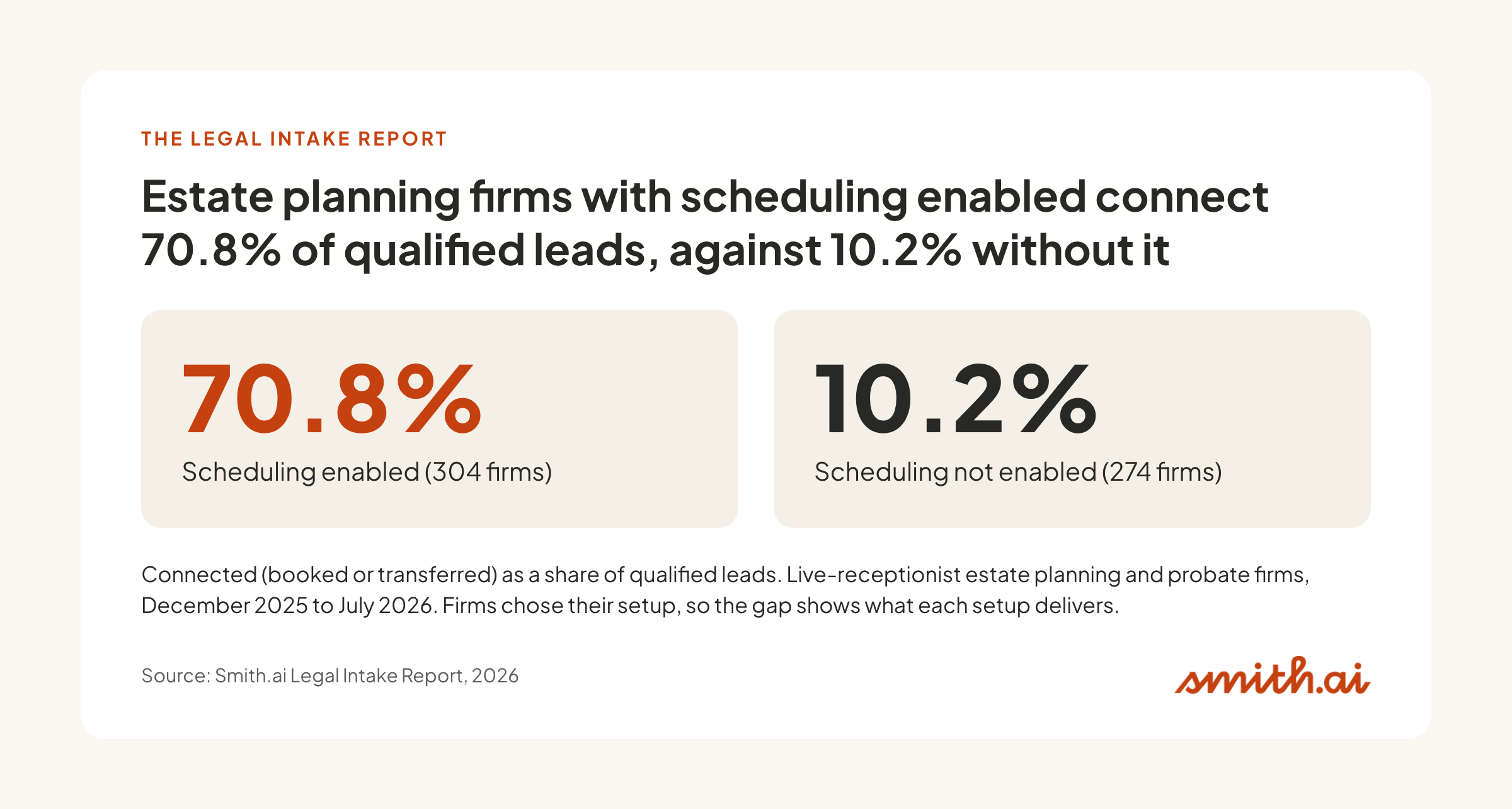
Two things stand out. The 60.6-point gap is the second widest in the report, behind workers' comp and disability at 67.1 points. And without scheduling, estate planning firms connect fewer qualified leads than personal injury firms (15.3%) or criminal defense firms (18.7%) that also don't schedule.
That fits the report's urgency explanation. A caller drafting a will rarely needs to be put through to an attorney this minute, so an intake that can only transfer has little to offer them. What that caller needs is a time on the attorney's calendar, and only a firm with scheduling enabled can give it on the call.
Firms chose their own setups, so these gaps show what each setup delivers for the firms that run it, not a guaranteed lift from switching.
An estate planning intake should establish whether the client needs new documents or updates, what the documents are for, who they cover, whether there are dependents, and whether any deadline is coming. Smith.ai's account build guide for law firms (August 2026) recommends seven estate planning questions and a booked consultation at the end of the call. Five of them:
Sample estate planning intake questions (end of call: schedule a consultation)
Source: Smith.ai account build guide for law firms, August 2026, as published in the Legal Intake Report. Applies to live and AI receptionists alike.
New versus update changes how the attorney prepares. An update means existing documents to review, so the firm can ask the client to bring them. The goal question gets the caller's own words on file before anyone mentions a trust or a will.
Questions 3 and 4 size the plan. A couple planning together and a parent with minor children need different conversations, and the attorney walks in knowing which one it is. The deadline question is short, but it's the one that tells the firm whether this caller can really wait a week. The full set adds two questions about the estate itself, and both are in the full report.
A probate intake should find out whether there's a will or trust, how the caller is related to the deceased, who the executor is, the county, and whether a dispute is expected. Smith.ai's guide lists seven probate and trusts questions. Five of them:
Sample probate and trusts intake questions
Source: Smith.ai account build guide for law firms, August 2026, as published in the Legal Intake Report.
Probate calls end differently from estate planning calls. The guide recommends "urgent: transfer first, schedule if no one answers; otherwise: schedule," and the report names "a disputed estate" as one that can need a lawyer today. Question 5 is the one that flags it.
The county question matters because, as the report notes, county and state often decide where a matter can be filed and whether the firm can take it. The relationship and executor questions name the people involved, so a conflict check can run before the consultation.
When an urgent probate transfer fails, book the consultation instead of taking a message. Across all practice areas, 77.1% of callers offered an appointment after a failed transfer take it.
Smith.ai runs end-to-end intake for law firms: more than 5,000 of them, with over 25 million calls handled since 2015. For an estate planning firm, that means every call answered, the firm's own question set asked, and qualified callers booked straight onto the attorney's calendar through appointment booking.
Firms choose how calls are staffed. An AI Receptionist takes routine calls; AI + human receptionists bring a live agent in when a call needs one, such as a grieving family member calling about probate; and Virtual Receptionists put people on every call, drawn from 500+ North America-based live agents. Intake answers sync to Clio, Lawmatics, and MyCase, so nobody re-keys the dependents or the executor's name. Per-call rates are on the pricing page.
For the complete estate planning and probate question sets and the full practice-area breakdown, download the Legal Intake Report.


