Take the faster path to growth. Get Smith.ai today.
Affordable plans for every budget.


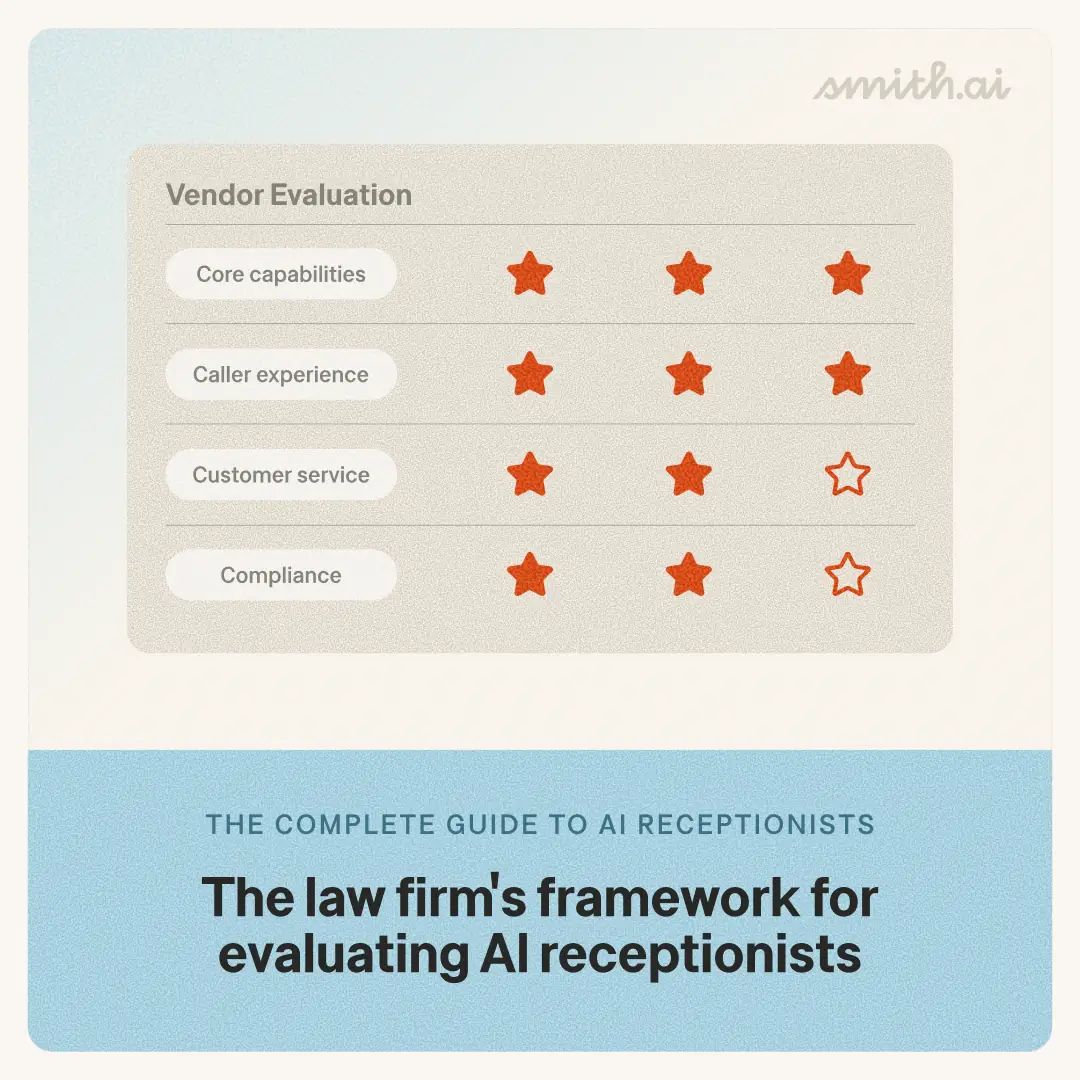
You're reading Part III of The Complete Guide to AI Receptionists.
In Part I, we broke down the AI call handling landscape: three tiers of solutions, the role of humans, and the iceberg problem that makes vendor evaluation so difficult. In Part II, you identified your pain points, ranked your jobs to be done, and calculated what missed calls are costing your firm.
Now it's time to start recruiting. You've defined the role. This post is about preparing for interviews.
Before you evaluate any vendor, document the infrastructure your AI receptionist will need to connect with. This step ensures your evaluation is grounded in your actual operational needs, not generic demos.
For each system, note what you have today and define the level of integration required. "We integrate with that" is the starting point — not the final answer.
Your phone system — Know your current provider and whether you own your number. Some vendors require full number porting; others work with call forwarding. This affects setup time, cost, and how disruptive implementation will be.
Your legal practice management system (LPMS) — Whether you use Clio, Filevine, Smokeball, or another platform, your receptionist solution will likely need to read from it, write to it, or both.
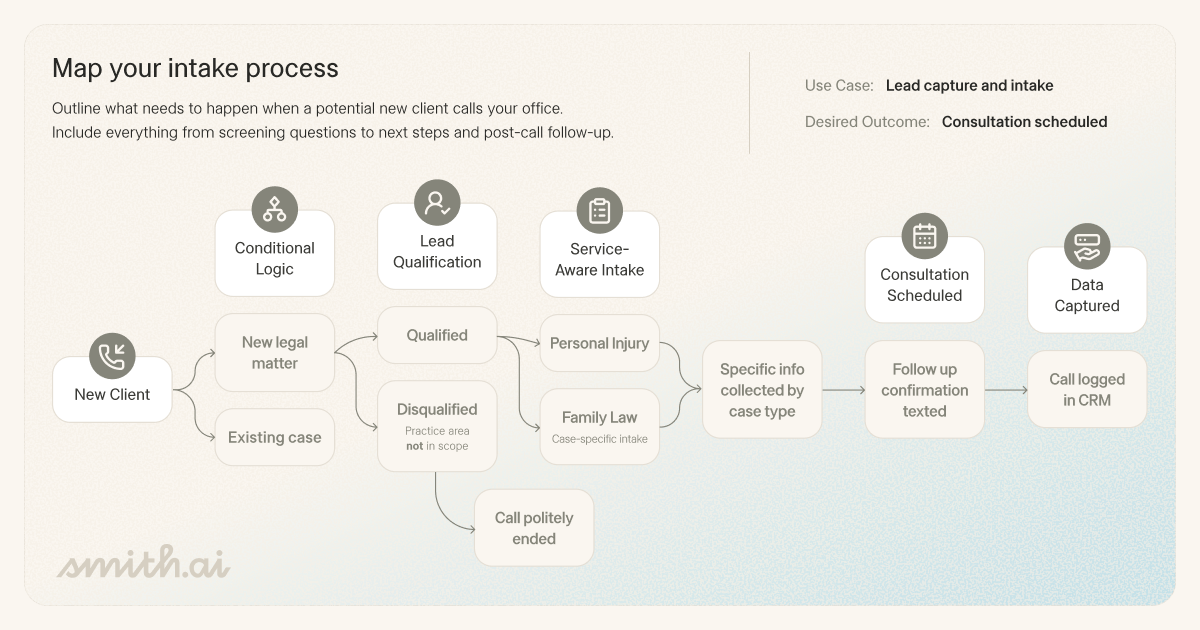
Your intake process — Document screening questions and qualification thresholds by practice area (e.g., personal injury case minimums, jurisdiction checks, conflict screening). This becomes the configuration blueprint for your intake call flows. For personal injury firms in particular, the stakes of a missed or mishandled intake call are especially high — see our guide to AI receptionists for personal injury law firms for a deeper look at how 24/7 intake and hybrid escalation address statute-of-limitations risk.
Your escalation path — Identify high-stakes scenarios: distressed callers, urgent client issues, opposing counsel. Define how these are handled today. This is often overlooked — and critical when evaluating vendors.
Bring this system map into every vendor conversation. It shifts the discussion from a generic demo to a focused evaluation of fit.
A comprehensive evaluation covers the four Cs: core capabilities, caller experience, customer service, and compliance. Considering criteria across all four will help you avoid the worst of the iceberg problem.
Your jobs to be done define your capabilities criteria. Identify your top priorities and clearly separate dealbreakers from acceptable trade-offs.
Focus on whether the system can reliably execute your highest-value workflows across different scenarios, not just in ideal conditions.
Key areas to assess:
Example priorities:
Your callers are often in high-stress situations. The quality of their first interaction directly influences trust, conversion, and client satisfaction.
Evaluate how well the system handles real-world variability, not just scripted flows.
Key areas to assess:
Hybrid models — combining AI with trained live agents — typically perform better in scenarios requiring empathy, judgment, or nuance. This is especially true for calls that arrive outside business hours; understanding how the after-hours call window affects missed-call revenue for law firms can sharpen how you weight escalation quality in your evaluation.
The vendor's service model is a critical component of long-term success. AI receptionist systems require ongoing iteration as your firm evolves.
Evaluate the vendor's ability to support both initial setup and continuous optimization.
Key areas to assess:
A vendor's operational maturity often determines whether the system improves over time or stagnates.
For law firms, compliance is inseparable from product evaluation. It directly affects your obligations around confidentiality, privilege, and client data protection.
Evaluate both technical safeguards and business stability.
Key areas to assess:
Vendor stability is part of compliance. Sensitive client data requires a partner with long-term viability.
Demos are curated. Your job is to push past the script.
Ask them to walk through your scenario, not theirs — e.g., a potential PI client after hours, an existing client asking for a case update, opposing counsel requesting a callback. Ask what happens when the caller goes off-script.
Watch how they handle hard questions. What happens when the LPMS integration breaks or what the AI does with a caller it can't understand. The best vendors welcome tough questions. Defensiveness tells you something.
Evaluate the vendor's process, not just their product. Do they ask about your practice areas, intake criteria, and conflict-check process? Or is it mostly them doing the talking? A vendor who wants to learn your firm is invested in your success.
The quality of a vendor's discovery process predicts the quality of the system they'll build.
Keep this list consistent across conversations so you can compare answers side by side.
Core capabilities
Caller experience
Customer service
Compliance
The most effective way to compare vendors is with a standardized scoring model. Use the same criteria and scale for each vendor, and include dealbreaker thresholds so critical failures override total score. At a minimum, score every vendor from 0 (dealbreaker) to 4 (excellent) across all 4 Cs: core capabilities, caller experience, customer service, and compliance. Solo and small firm practitioners evaluating options at this stage may also find it useful to review our comparison guide to answering services for small law firms, which maps common service tiers to firm size and legal CRM compatibility.
When you tally the scores, you're not looking for the highest number. You're looking for the best fit with no unacceptable gaps.
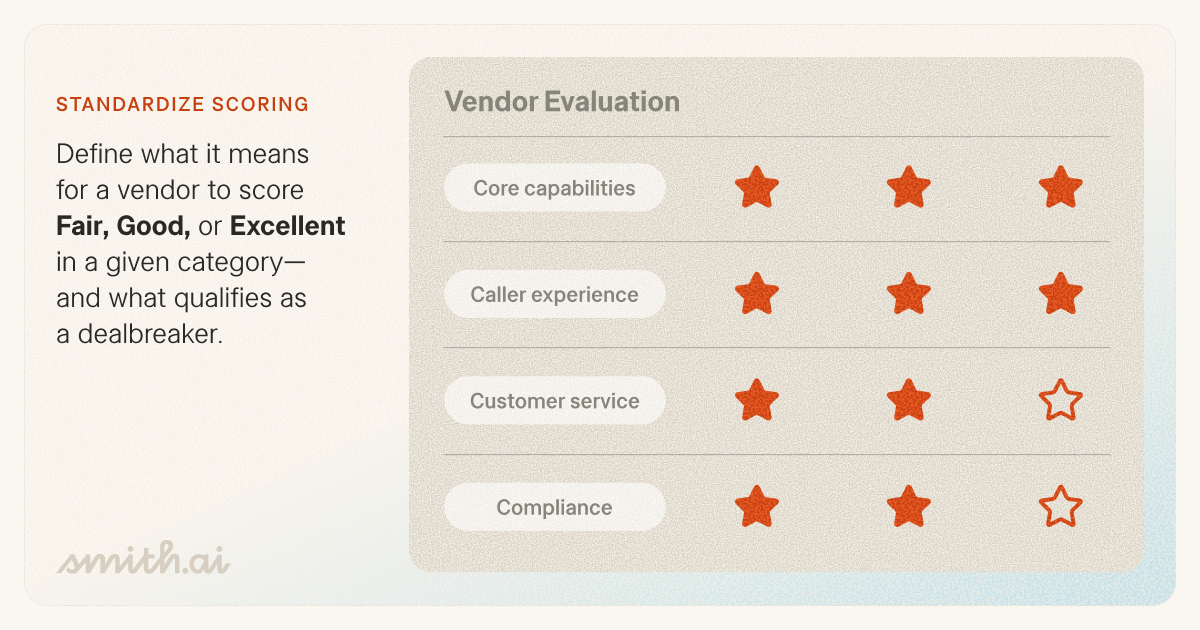
Coming soon: A downloadable scoring template you can use in every vendor conversation.
In Part IV, we'll cover how to use your evaluation results to make a confident decision, including how to define "good enough," avoid over-optimization, and move forward without second-guessing.
Stay tuned for The Complete Guide to AI Receptionists, Part IV.
Want one-on-one help mapping your requirements to the right solution? Book a free consultation with a product expert.

Aaron is the CEO and co-founder of Smith.ai. Formerly CTO of The Home Depot and co-founder of Redbeacon, he also played a pivotal role in Google Video's inception and later led YouTube's monetization efforts.


